
Cycling betting odds in Great Britain
 Available in US
Cycling betting odds look thin next to a Premier League match. A pre-race favourite for a Grand Tour will trade at 2/1 or shorter weeks before the race begins, then drift to 5/1 by the final week as form tells and the field narrows. Stage markets are different again: a sprint stage is usually a two-horse call between two or three named sprinters, and the book pays for the field to believe one of them wins. Reading those prices well is the same skill as reading any other market — the difference is that cycling markets are smaller, the field is longer, and the bookmaker’s margin is harder to see in a price because every rider’s line is set so the sum exceeds 100% in a way a reader has to know to look for.
This page covers cycling betting odds in Great Britain: how prices are built from the bookmaker’s margin, what the three Grand Tours look like to a bettor, the markets licensed GB bookmakers offer on a stage race, and the licensed operators that take cycling business in 2026. The figures are current as of October 30, 2026 and were checked against the Gambling Commission’s public register.
Staying in control while betting on cycling
Cycling markets run for weeks. A Grand Tour sits on the cycling calendar for three weeks at a stretch, with two stages a day on key weekends and odds refreshed each morning as the general classification moves. A bettor who starts a Grand Tour with a plan to bet across stages has to manage a bankroll over twenty-three days, which is a longer horizon than a Saturday accumulator and a different kind of temptation. The temptation is not the stake, it is the next stage: there is always another stage.
The British safer-gambling framework gives a bettor three tools that matter for a long event. The first is a deposit limit on the bookmaker’s account, which the operator must offer and which the customer sets; the second is GAMSTOP, the national self-exclusion register, which blocks a person from every licensed online operator for six months, one year, five years, or five years with auto-renewal and a further seven years after the minimum period; the third is the National Gambling Helpline run by GamCare, free from any UK phone. None of these are things the bettor hopes to use; they are the scaffolding the bettor puts in place before the first stage.
Identity verification is part of the scaffolding at every GB-licensed site. A bettor cannot deposit, place a bet or claim a free bet without name, address and date of birth being checked — that has been the rule since 7 May 2019. At higher spend, a financial vulnerability check (in force since 28 February 2025) flags a public-record check once a customer’s deposits minus withdrawals exceed £150 in a rolling 30 days. It is not a credit check. A bettor who wants to keep their hobby private should expect these checks, not be surprised by them.
The harder conversation is the one the bettor has with themselves at stage twelve of a Grand Tour, when the favourite has just lost forty seconds and a market that was 3/1 this morning is now 7/1. That is the point of a deposit limit. A bettor who set £200 on the race week and is at £140 by stage ten is not the bettor who set £200 on Tuesday and is at £400 by Friday. The bookmaker has no way to know which one sits at the keyboard. The bettor does.
Where to get help: GamCare’s National Gambling Helpline, GambleAware, NHS gambling clinics, and Gamblers Anonymous. The framework above sits around every operator on the page that follows.
The sport: how road cycling is run
The UCI (Union Cycliste Internationale), based in Switzerland, has governed road cycling since 1900 and runs the men’s and women’s road world championships each year. Road cycling’s competition pyramid starts with national federations and feeds into UCI WorldTeams and UCI ProTeams, which contest the top tier of the calendar: the UCI WorldTour, created in 2005 as the ProTour and renamed the WorldTour in 2011. The WorldTour is where the Grand Tours sit.

The three Grand Tours are the Giro d’Italia (first held in 1909), the Tour de France (1903) and the Vuelta a España (1935). UCI rules cap a Grand Tour between fifteen and twenty-three days of racing, with two rest days in most editions. Each race has its own leader’s jersey: pink (maglia rosa) in the Giro, yellow (maillot jaune) in the Tour, red (maillot rojo) in the Vuelta. The Grand Tours are the events that pull the deepest betting interest in road cycling: a stage winner market on a flat day and an overall winner market that runs for three weeks are not the same kind of bet, and a bookmaker’s menu on a Grand Tour week is much wider than its menu on a one-day Classic.
The 2026 Tour de France and what it shows about a market
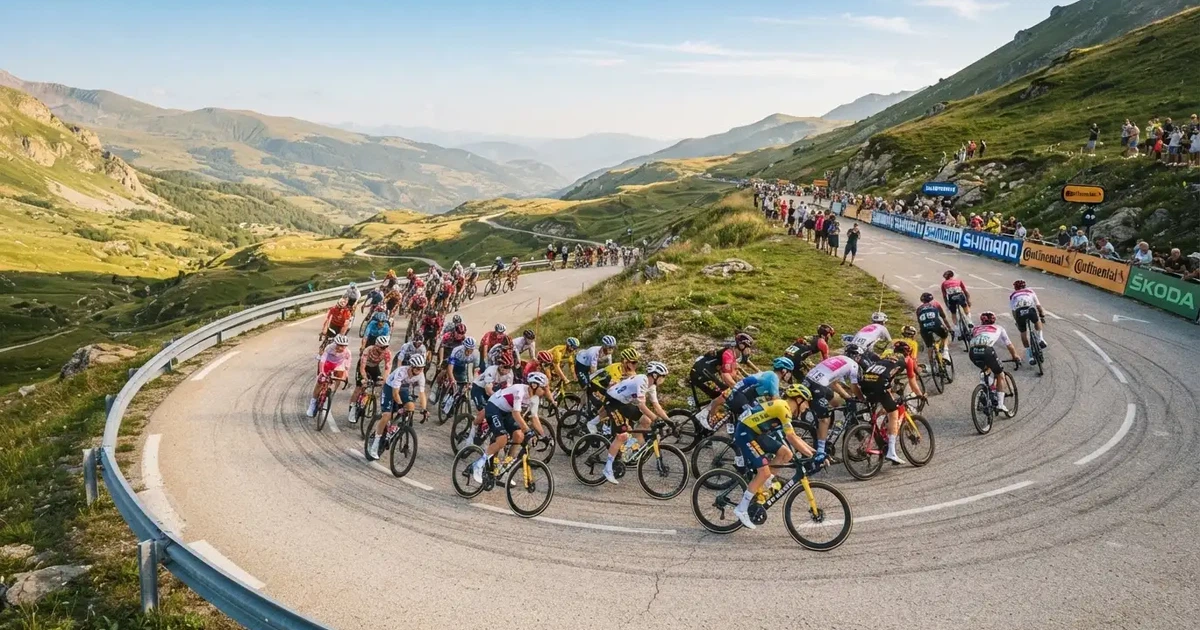
The 2026 Tour de France ran from 4 to 26 July 2026, starting in Barcelona with a team time trial and finishing on the Champs-Élysées in Paris, over twenty-one stages and 3,245 km with twenty-three teams. Tadej Pogačar (UAE Team Emirates, Slovenia) won the race, his fifth Tour victory. A market that opened months before the race with Pogačar and Jonas Vingegaard at the front of the betting has a clear shape at the end of July: Pogačar, who arrived as the strongest climber and time triallist, delivered on the price. Markets on stage races resolve over days, not minutes, and a Grand Tour general classification bet is closer to ante-post horse racing than to a Saturday football accumulator.
For a reader looking at how a cycling bookmaker sets prices, the Tour is the cleanest example. There were around thirty named riders priced for the general classification before the race began, with the top six trading at single-digit decimal odds and the rest at double digits and beyond. The sum of implied probabilities of every rider priced — the overround — exceeded 100% by a margin that depends on the bookmaker. A reader can see that margin by converting each decimal price to an implied probability (1 ÷ decimal odds) and adding them up; the gap above 100% is the book’s take on the market.
Beyond the Grand Tours
The WorldTour calendar outside the Grand Tours includes one-day Monuments (Milan–San Remo, the Tour of Flanders, Paris–Roubaix, Liège–Bastogne–Liège and the Tour of Lombardy), week-long stage races such as the Critérium du Dauphiné, Paris–Nice and the Tour de Romandie, and the spring Classics that run through Belgium and northern France. Bookmakers price the Monuments and the major stage races heavily; smaller stage races carry a thinner card. A reader who wants a year-round cycling betting calendar has one in the WorldTour, with the busiest months running from March to October.
The Olympics sit outside the WorldTour but are part of the international road calendar in Olympic years. A GB-licensed bookmaker treats an Olympic road race as a real-event sport under its remote general betting standard (real events) licence and prices it like any other one-day race. Women’s road cycling has its own WorldTour calendar and its own world championships, and the biggest women’s races (the Tour de France Femmes, Liège–Bastogne–Liège, the Tour of Flanders) carry their own betting markets at major bookmakers.
The bookmakers: who takes cycling bets in Great Britain
The ten operators below are GB-licensed bookmakers that carry a cycling menu. Each holds a Gambling Commission remote betting licence listed on the Commission’s public register, and each offers markets on Grand Tours, week-long stage races and one-day Classics during the road season. The comparison table at the end of the section collects the licence details and what each operator’s own terms say about its cycling offer.
Cycling is a small market compared with football or horse racing, so the depth of menu varies more from operator to operator than the depth of football menu does. A reader who wants outright winner, stage winner and head-to-head markets on every WorldTour race needs to compare operators by season; a reader who wants outright winner on the Grand Tours and a market on the Tour de France yellow jersey has a wider choice.
DragonBet — Welsh focus, in-play and bet builder
DragonBet (licensee DragonBet Ltd, Gambling Commission remote licence 064908-R-339041-003) runs an app published by dragonbet ltd that carries Welsh football and rugby, racing, American football, in-play betting and bet builder markets. Cycling sits inside its general sportsbook rather than as a featured sport; the depth of menu is the standard general-sportsbook list rather than a cycling-specialist list. DragonBet is a strong fit for a customer who wants the Welsh-interest markets alongside a cycling outright and a stage winner bet during the Tour de France; a customer whose interest is cycling-only will find thinner in-season coverage than the specialists. Worth it for the reader who values the Welsh markets; less so for the cycling-first reader.
Fafabet — Best Odds Guaranteed on racing and a general sportsbook
Fafabet (licensee Taichi Tech Limited, Gambling Commission remote licence 057385-R-333191-006) pays Best Odds Guaranteed on UK and Irish horse racing win and each-way bets from 9am on race days: if the starting price is bigger than the price the bettor took, the bigger odds are paid. The cycling offer sits in the general sportsbook rather than as a featured sport, and the depth of stage-race markets is at the general-sportsbook level. Best Odds Guaranteed is a horse-racing promotion and does not extend to cycling, so a reader who follows the Tour and the racing calendar in parallel gets a clear benefit; a reader who bets only on cycling gets a thinner menu than the specialists.
Betboro — sports welcome offer on the first qualifying wager
Betboro (licensee Webmedia Development N.V., Gambling Commission remote licence 044181-R-324363-007) runs a sports welcome offer described in its own terms as a 100% matched free bet of up to £25 on the first qualifying wager, requiring a debit card deposit of at least £10 and a first bet of £5 to £25 with at least three selections each at 3/5 (1.60) or higher. The bonus is a free bet rather than a cash bonus, and a free bet usually does not return its stake with a winning wager — the value is in the winnings, not the stake. The minimum price of 1.60 on every leg is a soft constraint on multi-leg bets that excludes short-priced favourites from being stacked. Cycling markets are part of the general sportsbook rather than a featured sport. Worth it for a bettor who plans a small qualifying accumulator at the start of a Grand Tour and wants a free bet to use across the race; less useful for a bettor who bets singles only.
Matchbook — betting exchange with cash out and live streaming
Matchbook (licensee Triplebet Limited, Gambling Commission remote licence 039504-R-319407-024, including remote betting intermediary) is a betting exchange — customers bet against each other rather than against a bookmaker’s margin. The exchange offers Bet Builder, multiples, in-play betting and live streaming of horse racing and greyhounds. A betting exchange prices a market differently from a traditional bookmaker: there is no built-in margin, the back side and the lay side sit close together, and the available liquidity depends on what other users have placed. A reader looking for sharper prices on a Grand Tour outright may find them on an exchange; a reader who wants the operator-built markets (each-way terms, enhanced place terms, named-rider specials) finds them on the traditional bookmaker side. Worth it for the price-sensitive reader who understands back and lay; less useful for the casual Grand Tour bettor who wants the traditional menu.
Spreadex — fixed-odds and spread betting in one app
Spreadex (licensee Spreadex Limited, Gambling Commission remote licence 008835-R-104580-022) combines fixed-odds and spread betting in one app, with one-click, auto and partial cash out, Bet Builder across fixed odds or spreads, and live streaming of UK and Irish horse racing, greyhounds, tennis, NFL and selected football. Spreadex is regulated by the FCA for spread betting and by the Gambling Commission for fixed-odds betting, and its own terms state that spread betting losses can exceed the deposit. That last point is the sharp one: spread betting on cycling is not the same as fixed-odds betting, and a stake that limits risk on a fixed-odds bet does not cap losses on a spread position. A cycling bettor who wants fixed-odds outright and stage markets gets them, with cash out added; a bettor drawn to spread markets on a Grand Tour should read the spread terms carefully because the loss is not capped at the stake. Worth it for the fixed-odds menu plus cash out; spread markets need a separate reading.
DAZN Bet — low minimum deposits and a small starting bank
DAZN Bet (licensee DZBT Limited, Gambling Commission remote licence 048756-R-327274-019) takes deposits from £5 by debit card, Apple Pay, Paysafecard, Trustly and Skrill, and £20 by PayPal, with no processing fees stated in its own help pages. The minimum stake on a cycling bet follows the general sportsbook floor; the £5 deposit floor matters most for a bettor whose bankroll is small enough that the £10 minimum elsewhere is a barrier. Cycling markets sit in the general sportsbook. Worth it for the bettor who wants to start with £5 and build a Grand Tour bank across stages; less compelling for the bettor who already deposits at the £10 minimum and wants a deeper cycling menu.
Bet Ahoy — small welcome bundle on first bets
Bet Ahoy (licensee Bet Ahoy Ltd, Gambling Commission remote licence 100094-R-341742-003) runs a welcome offer of “Bet £10 & Get £10 in Free Bets”, split as a £5 sports bet and a £5 acca, as stated in its app listing. The bundle is small compared with the larger matched-deposit offers on the market, and the acca leg is the more interesting part for a cycling bettor who plans a stage-race multiple across the Tour. Cycling markets sit in the general sportsbook. A solid starting point for a bettor looking to use a small free bet on a Grand Tour stage multiple, but it does not offer the same welcome value as a matched-deposit bonus.
London Bet — combined sportsbook and casino
London Bet (licensee Thistle Bet Limited, Gambling Commission remote licence 066162-R-340278-004) combines sports betting — football, tennis, horse racing, greyhounds, darts, golf, cricket, NFL, NBA, MLB, snooker — with Pragmatic Play casino slots and live in-play betting. Cycling sits inside the sports menu at the general-sportsbook level rather than as a featured sport. A reader who plays both sportsbook and casino from one account has a convenient single wallet; a reader whose interest is cycling-only gets a thinner menu than the specialists. A convenient option for a reader who combines a casual interest in cycling with a regular casino habit; for the specialist, the shallower menu is a drawback.
10bet — Cash out, Bet Builder and Live Streaming
10bet (licensee Blue Star Planet Limited, Gambling Commission remote licence 043173-R-322899-023) runs a sportsbook covering football, tennis and horse racing with Cash out, Bet Builder and Live Streaming. Cycling is part of the general menu; the cash out and bet builder features are useful during a Grand Tour because a stage position can move quickly and a bettor who wants to lock in profit mid-stage has the option. Worth it for the cash-out and bet-builder features during a stage race; less compelling for the bettor who bets outright-only and does not use cash out.
Hollywoodbets — acca insurance on the first losing accumulator
Hollywoodbets (licensee Hollywoodbets International UK Limited, Gambling Commission remote licence 053028-R-330019-013) runs a sports welcome offer: a new player who deposits £10 or more by card gets their stake back as a free bet of up to £30 on their first qualifying losing accumulator — stake £10+, three or more legs, odds of 4/1 or greater, settled within seven days, one free bet per customer. The acca insurance structure is the more interesting feature for a cycling bettor planning a multi-stage bet, because the structure protects against the one leg that lets down the rest. Cycling markets sit in the general sportsbook. Worth it for the acca-insurance structure on a multi-stage bet across the Tour; less compelling for singles-only bettors.
Overview: how cycling betting markets are built
A bookmaker’s cycling menu opens with outright winner markets weeks before a Grand Tour begins and contracts as the race approaches. Outright winner is the simplest market: pick the rider who finishes the race with the lowest aggregate time. Each-way terms apply on outright winner, with place terms usually a quarter of the odds for the first three or four places depending on the bookmaker. Stage winner markets open close to each stage, with head-to-head markets and group winner markets added in the days before. The menu during a Grand Tour week is wider than during the rest of the road calendar.
The markets available to a GB bettor are not set by statute — no list of permitted bets exists in the Gambling Act 2005. A bookmaker holding a remote general betting standard (real events) licence may offer any market on a real cycling event under its own house rules and the LCCP conditions. That includes outright, stage winner, head-to-head, group winner, King of the Mountains, points classification and team classification on Grand Tours, plus match markets on one-day races. A bookmaker’s choice to offer a particular market is a commercial decision, and the depth of menu varies between operators.
In-play markets run during stages. A bookmaker that offers in-play on football offers in-play on cycling by default; the controls around it are the operator’s licence conditions rather than a statutory rule. A bettor who places an in-play bet during a breakaway has to weigh the speed at which the bookmaker’s price moves against the speed of the race; a price taken just before a crash is not the same price as one taken just after.
What a bookmaker’s margin looks like in cycling prices
Every price on a bookmaker’s site sits inside a margin the bookmaker takes on the market. The margin is the gap between 100% and the sum of implied probabilities of every outcome priced. For a two-way market — a sprint stage winner between two named sprinters — the arithmetic is straightforward. Take decimal odds of 1.90 and 1.90: each price implies a probability of 1 ÷ 1.90 = 0.5263, and the sum is 1.0526, or 105.26%. The book’s payout share is 1 ÷ 1.0526 = 95.00% and the margin is 5.00%.
For a more realistic cycling market — a stage winner with eight named riders priced — the math generalises to any number of outcomes: payout share = 1 ÷ (sum of 1 ÷ odds for each outcome), and margin = 1 − payout share. The margin on an eight-rider stage winner is typically larger than the margin on a two-way match because each outcome’s implied probability is smaller and rounding eats more of the price. A bettor who wants to compare bookmakers on the same Grand Tour should add up the implied probabilities of the named riders on each site; the smaller the sum, the tighter the margin.
The margin is not the only thing the bettor pays. The margin is the average take across the market; a bet on the favourite loses more to margin per unit staked than a bet on an outsider, because the favourite’s share of the pool is larger. The arithmetic of expected loss sits underneath the margin: on a market with a 5% margin and a £100 stake, the expected cost is £5 over the long run. That £5 is what the bookmaker keeps on average, and it is the price the bettor pays for the chance to win.
Worked example: a two-way market at 1.90 / 1.90
Consider a head-to-head market between two sprinters, each priced at decimal odds 1.90 (fractional 9/10). The implied probability per outcome is 1 ÷ 1.90 = 0.5263, the sum is 1.0526, the payout share is 95.00%, and the margin is 5.00%. On a £10 stake at 1.90, a winning bet returns £19.00 — stake £10, profit £9.00. Over many such bets at the same margin, the expected loss per £10 stake is £0.50.
The same calculation with one runner priced at 1.50 and the other at 3.00: 1 ÷ 1.50 = 0.6667, 1 ÷ 3.00 = 0.3333, sum 1.0000, payout share 100%, margin 0% — a margin-free book, which is what a betting exchange looks like when back and lay meet at the same price. A traditional bookmaker on the same race will not show that pair; the prices will be 1.45 and 2.80 or thereabouts, with implied probabilities 0.6897 and 0.3571, sum 1.0468, overround 4.68%. A bettor reading the menu should compare bookmakers on the same named market, not on a price they remember from a different race.
The point of the arithmetic is not to teach the reader to compute a margin for every market. It is to give the reader a way to compare two prices that look similar. Two books with the same favourite at 2/1 are not the same market if one has the field priced tighter than the other; the field is where most of the margin hides.
Regulation: what a GB licence means for a cycling bettor
A bookmaker that takes bets from customers in Great Britain needs a Gambling Commission licence under sections 33 and 36 of the Gambling Act 2005 as amended by the Gambling (Licensing and Advertising) Act 2014. A licence issued in Malta or Curaçao is not a substitute: the point-of-consumption test means a GB customer bet triggers the GB licence requirement regardless of where the operator is based. The Commission’s public register is the whole test of who holds a licence; it can be searched by business name, trading name, domain or account number. A reader who wants to verify a brand holds a licence searches the register and checks the licence status, the licence categories and the trading names attached to the licence.
The licence categories that matter for a cycling bettor are remote general betting standard (real events) — the standard online sportsbook licence — and remote betting intermediary, the exchange licence. A bookmaker holding only a remote general betting standard (virtual events) licence cannot offer real cycling events; a bookmaker holding a remote pool betting licence can take pool bets on horse or dog racing but cannot offer fixed-odds cycling without the standard real-events licence. The register shows the categories under each licence. A reader who wants to confirm a cycling book is licensed for real cycling checks the register entry for “remote general betting standard (real events)”.
Several brands can run under one licensee — Ladbrokes and Coral under Entain, Paddy Power and Betfair under Flutter — and the register shows this in the trading names section. A reader who sees two competing brands with the same parent does not get two independent complaints routes; the licensee is the regulated entity.
Financial spread betting is a separate regulatory regime under the Financial Conduct Authority, not the Commission. Spreadex, which runs both fixed-odds sports betting and spread betting on its platform, holds a Commission licence for the fixed-odds side and an FCA authorisation for the spread side. The two regimes have different consumer protections and different loss profiles — fixed-odds bets cap the loss at the stake, spread bets can lose more than the deposit.
Player protection under a GB licence
The safer-gambling framework under a GB licence covers five areas the cycling bettor meets directly:
- Identity verification before the first deposit. Name, address and date of birth are verified before a customer can deposit, gamble or use a free bet. This has been the rule since 7 May 2019. A reader who wants anonymous play does not get it from a licensed site.
- GAMSTOP. The national multi-operator online self-exclusion scheme. A customer who registers with GAMSTOP is blocked from every GB-licensed online operator for the period chosen — six months, one year, five years, or five years with auto-renewal — and a further seven years after the minimum period unless they ask GAMSTOP to remove it. Betting shops use a separate service.
- Financial vulnerability checks. Since 28 February 2025, a public-record check (bankruptcy, county court judgments) kicks in once a customer’s deposits minus withdrawals exceed £150 in a rolling 30 days. It is a public-record check, not an income check and not a credit reference check. A bettor who crosses £150 in net deposits over thirty days should expect to be asked questions about their finances.
- Deposit limits. Operators must offer a gross deposit limit on a fixed time frame. The first changes applied from 31 October 2025, a second phase was postponed to 30 September 2026, and whether that second phase is live is not established. A bettor who wants a deposit limit sets one on the operator’s site; the operator must offer the tool.
- Bonus cap. Wagering requirements on bonuses are capped at 10x since 19 January 2026 — a £10 bonus at 50x is illegal; under the cap no more than £100 needs to be wagered. Mixed-product promotions (an offer requiring bets on two or more product types such as betting, casino, bingo or lottery) are banned. Whether the cap applies to free bets with no wagering condition and any cap on the money value of a bonus are not established; a reader who values a clean offer benefits from the cap, a reader who liked a 50x bonus loses the option.
A reader who bets at a licensed site gets all five of those protections. A reader who bets at an unlicensed site gets none of them, and has no British complaints route if the operator withholds funds.
Advertising and offers
The Gambling Commission does not license advertising; advertising is governed by the CAP Code (non-broadcast) and BCAP Code (broadcast), enforced by the ASA, alongside the LCCP marketing conditions. Section 16 of the CAP Code requires marketing to be socially responsible, not of strong appeal to under-18s, and not to feature anyone who is or seems to be under 25 gambling or playing a significant role. “Whistle-to-whistle” is an industry code, not law: since 1 August 2019, betting advertisements are not shown on TV from five minutes before a live sporting event to five minutes after it, before the 9pm watershed, with horse and greyhound racing excluded.
The Premier League clubs’ voluntary withdrawal of gambling sponsorship from the front of matchday shirts, starting from the 2026/27 season with sleeves and hoardings remaining, is a voluntary measure by the clubs, not law. The Commission’s enforcement toolkit is operational: cease-and-desist notices, search-engine referrals, work with registrars, hosts and payment providers, and court-order DNS blocking powers that have been granted or are about to be granted. None of this is the bettor’s problem directly; it is the background that explains why an unlicensed brand targeting GB customers eventually disappears from search results.
Tax
The bettor pays no tax on betting winnings in Great Britain (general information, not tax advice). General Betting Duty is the operator’s tax, currently 15%, with a new remote betting rate of 25% from 1 April 2027 while remote bets on UK horse racing, self-service betting terminal bets, pool betting and in-person betting stay at 15%. Until 1 April 2027 the remote rate stays at 15%; whether operators pass the duty on through odds is not established. A reader who wants to bet on cycling pays no tax on winnings and should not expect the operator to publish a tax line on the betting slip.
Offshore and unlicensed sites
A GB licence is compulsory at the point of consumption. Providing gambling facilities in Great Britain without the licence the Act requires is an offence under section 33 of the Gambling Act 2005 — on summary conviction up to 51 weeks’ imprisonment, a fine up to level 5, or both; six months in Scotland. The offence is aimed at the operator, not the customer; no offence aimed at a customer who merely bets on an unlicensed site was found. The loss to a customer who bets on an unlicensed site is the loss of British protections: no GAMSTOP coverage, no Commission complaints route, no approved dispute-resolution body, no British consumer redress if funds are withheld, no 10x bonus cap, no £150 vulnerability check.
Honest framing: licensed means checks, limits, GAMSTOP, the bonus cap, but also verification before the first bet. Unlicensed means none of those protections and possible loss of funds. Neither is “the safe choice” by default; the licensed route has the formal British framework, the unlicensed route does not.
Choosing among the ten
The table below sets out the ten bookmakers reviewed above by licence and cycling-specific terms. The “what the operator’s own terms state” column is the cycling-relevant fact from each operator’s own page or app listing as cited in the operator sections.
| Brand | Gambling Commission remote licence | Licence holder | What the operator’s own terms state |
|---|---|---|---|
| DragonBet | 064908-R-339041-003 (account 64908) | DragonBet Ltd | App carries Welsh football and rugby, racing, American football, in-play betting and bet builder markets; cycling sits in the general sportsbook. |
| Fafabet | 057385-R-333191-006 (account 57385) | Taichi Tech Limited | Best Odds Guaranteed on UK and Irish horse racing win and each-way bets from 9am on race days; cycling is in the general sportsbook. |
| Betboro | 044181-R-324363-007 (account 44181) | Webmedia Development N.V. | Sports welcome offer is a 100% matched free bet of up to £25 on the first qualifying wager, debit card deposit £10+, first bet £5–£25 with three+ selections at 3/5 (1.60) or higher. |
| Matchbook | 039504-R-319407-024 (account 39504) | Triplebet Limited | A betting exchange — customers bet against other users — with Bet Builder, multiples, in-play betting and live streaming of horse racing and greyhounds. |
| Spreadex | 008835-R-104580-022 (account 8835) | Spreadex Limited | Combines fixed-odds and spread betting in one app with one-click, auto and partial cash out, Bet Builder, live streaming of UK and Irish horse racing, greyhounds, tennis, NFL and selected football; spread betting losses can exceed the deposit. |
| DAZN Bet | 048756-R-327274-019 (account 48756) | DZBT Limited | Deposits from £5 by debit card, Apple Pay, Paysafecard, Trustly and Skrill, and £20 by PayPal, no processing fees. |
| Bet Ahoy | 100094-R-341742-003 (account 100094) | Bet Ahoy Ltd | Welcome offer “Bet £10 & Get £10 in Free Bets” — a £5 sports bet and a £5 acca. |
| London Bet | 066162-R-340278-004 (account 66162) | Thistle Bet Limited | Sportsbook covers football, tennis, horse racing, greyhounds, darts, golf, cricket, NFL, NBA, MLB, snooker, with Pragmatic Play casino slots and live in-play. |
| 10bet | 043173-R-322899-023 (account 43173) | Blue Star Planet Limited | Sportsbook covers football, tennis and horse racing with Cash out, Bet Builder and Live Streaming. |
| Hollywoodbets | 053028-R-330019-013 (account 53028) | Hollywoodbets International UK Limited | Sports welcome offer refunds the stake as a free bet of up to £30 on the first qualifying losing accumulator — £10+ stake, 3+ legs, odds 4/1 or greater, settled within 7 days; one free bet per customer. |
A reader whose priority is a tight margin on Grand Tour outrights should compare the named bookmaker markets with the exchange price on Matchbook for the same selection; the exchange prices are set by other users and the spread between back and lay is the effective margin. A reader whose priority is the breadth of in-stage markets should look at 10bet and Spreadex for cash out during stages. A reader whose priority is a small starting stake should look at DAZN Bet’s £5 deposit floor. A reader whose priority is a free bet to use across the Tour should weigh Betboro, Bet Ahoy and Hollywoodbets — three different shapes (matched free bet, free bet bundle, acca insurance), each with its own conditions.
Cycling markets in detail
A bettor reading a bookmaker’s cycling menu during the Tour de France sees four kinds of market. The first is outright winner on the general classification, open weeks before the race and settling on stage twenty-one. The second is stage winner, opened close to each stage and settling within hours. The third is the head-to-head or match market between two named riders, usually a one-day or one-stage proposition. The fourth is classification markets — King of the Mountains, points classification, young rider classification, team classification — which run across the whole race and settle on the final day.
Outright markets move during the race. The favourite’s price shortens with each successful mountain stage and drifts with each bad day; a rider who loses forty seconds on stage twelve moves from 7/1 to 25/1 by stage thirteen. A bettor who took 7/1 before the race and cashes out at 25/1 mid-race locks in a small profit; a bettor who holds the position hopes for a comeback that the new price reflects. The cash out feature at 10bet and Spreadex is the tool for the first bettor; the discipline to hold is the tool for the second.
Stage winner markets are settled by the day’s result. A sprint stage settles within a few minutes; a mountain stage settles within the closing hour. A bettor who placed a stage bet at the start of the day does not need to watch the price move, only the result. A bettor who placed an in-play bet during the stage is exposed to the operator’s price moves, which are set by the bookmaker’s algorithms and the live market. The in-play market on a mountain stage can suspend for several minutes during a key climb while the bookmaker reprices — a bettor who wants an in-play position during a summit finish needs to accept that prices disappear at the worst moments.
Head-to-head markets pair two named riders and ask which one finishes ahead. A head-to-head between two domestiques is a near-coin-flip market on a flat stage; a head-to-head between two GC contenders is a market on the whole race. The bookmaker’s margin on a head-to-head is smaller than on a multi-rider outright because there are only two outcomes — a two-way market at 1.90 / 1.90 is the cleanest example the page has shown.
Each-way betting on cycling
Each-way betting splits a stake into two equal bets: one on the rider to win, one on the rider to place. The place terms vary by race and by operator — a Grand Tour outright typically pays a quarter of the win odds for the first three or four places; a one-day Classic typically pays a quarter for the first three. Each-way doubles the stake: a £10 each-way bet costs £20. The place part returns even if the rider does not win, which is what makes each-way attractive on a Grand Tour where the favourite’s win price is short and the place price is a useful fallback.
A reader who bets each-way on a Grand Tour should check the operator’s place terms before placing the bet. A bookmaker that offers a quarter the odds for three places is a different proposition from a bookmaker offering a fifth the odds for four places. The arithmetic of each-way value is a separate calculation from the margin and is not on this page.
Combination bets and the multiplication of price
A combination bet (accumulator, acca) multiplies the odds of each leg into one price. Two legs at 2.00 and 3.00 give a combined price of 6.00; three legs at 2.00, 3.00 and 4.00 give 24.00. The return on a £10 acca at 6.00 is £60; at 24.03 (after rounding), it is £240.30. The trade-off is that every leg has to win for the acca to pay, and the book’s margin compounds with each leg added. A four-fold acca on four short-priced favourites has a larger expected loss than four singles on the same selections, because each leg takes its own margin and the acca pays only if all four legs win.
Betboro’s welcome offer requires three or more selections each at 3/5 (1.60) or higher — a constraint that excludes a single-sport favourite from the qualifying bet and pushes the bettor toward an acca. Hollywoodbets’ acca insurance refunds the stake as a free bet on a losing accumulator with three or more legs at 4/1 or greater. Both offers have a built-in assumption: that the bettor will combine legs. A reader who prefers singles does not benefit from either offer as written.
Reading a price: fractional and decimal odds
British bookmakers write prices in fractional form (5/1, 11/4, evens) as the default and in decimal form (6.00, 3.75, 2.00) as the alternative. The conversion is fractional by a fractional ÷ denominator + 1: 5/1 → 6.00, 11/4 → 3.75, evens (1/1) → 2.00. Decimal odds express the total return per unit stake, including the stake; fractional odds express the profit per unit stake, excluding the stake. A reader who sees a price at 5/1 in a headline and wants to compare with a decimal price elsewhere converts by the rule above. A bet at 5/1 on a £10 stake returns £60 (£50 profit plus the £10 stake); the same bet in decimal form is at 6.00 and returns £60 from a £10 stake.
The conversion is mechanical and applies the same way in both directions. A reader who prefers to think in decimal should set the bookmaker’s site to decimal odds in the settings; most GB bookmakers offer both formats.
Markets beyond cycling: what the bookmaker covers
A bookmaker’s cycling menu sits inside a wider sportsbook that includes football, horse racing, tennis, golf, cricket, American football, darts, snooker and the greyhounds calendar. The depth of menu on each is independent. A reader who bets cycling during the summer and horse racing during the winter has a different priority each season; a reader who bets football weekly has a different priority again. The table on the brand comparison covers only the cycling-relevant terms from each operator’s own page or app listing.
Matchbook’s offer is structurally different from the others — a betting exchange rather than a traditional bookmaker. The reader who understands back and lay gets sharper prices on a Grand Tour outright because there is no built-in margin; the reader who wants a traditional menu of stage winner, head-to-head and each-way terms does not. Spreadex is structurally different within a different axis — fixed-odds plus spread betting in one app — and the spread side is a separate product with separate risk.
Live features: cash out, bet builder and live streaming
Cash out settles a bet before the event has finished, at a price the operator offers in real time. A bettor who backed the favourite at 3/1 before the race and the favourite is now trading at evens can cash out for a small profit. The price is set by the operator and is typically less generous than the price a betting exchange would offer; the convenience is that it is one click and the bet is closed. 10bet, Spreadex and Matchbook offer cash out; the others may offer it on selected markets.
Bet Builder combines multiple markets from a single event into one bet. A bettor who backs a sprinter to win a stage and the race to be won by a sprint can build that as a Bet Builder at a combined price. Bet Builder+ at 365bet combines markets from one event into a single bet, available pre-match and in-play; Spreadex runs Bet Builder across fixed odds or spreads. The price of a Bet Builder reflects the bookmaker’s combined margin on the underlying markets; a Bet Builder on two short-priced favourites has a smaller margin than a Bet Builder on two long-priced outsiders.
Live streaming of cycling is less common than live streaming of football or tennis. A GB bookmaker that streams cycling usually streams the Grand Tours and the major one-day races during the season; smaller races and women’s races are less likely to be covered. A reader who wants to watch a race on the bookmaker’s app should check the operator’s live-streaming calendar during the road season.
A note on women’s cycling
Women’s road cycling has a WorldTour calendar, the Tour de France Femmes (running since 2022), the Giro d’Italia Women, the Vuelta Femenina and a series of one-day races. The depth of betting markets on women’s cycling varies by operator and by event; the bigger races carry outright and stage winner markets at major bookmakers. A reader who follows the women’s calendar in parallel should check the operator’s cycling menu in-season.
How to read prices across bookmakers
A bookmaker’s menu is not the same thing as a market. A price is the bookmaker’s offer on a selection; a market is the set of all prices on all selections in a named event. Comparing two bookmakers on the same market means looking at the prices on the same set of selections, not at one price from one bookmaker and one from another. The reader who sees Pogačar at 5/2 on one site and at 3/1 on another should not compare those prices directly without checking the rest of the market.
The arithmetic of comparison is the payout share. On a Grand Tour outright, the sum of implied probabilities of every rider priced tells the reader what the bookmaker keeps. A sum of 1.05 is a 5% margin; a sum of 1.08 is an 8% margin. A reader who adds up the implied probabilities of the named riders on two bookmakers’ sites gets a direct comparison. The reader who just looks at the favourite’s price misses the rest of the field, where most of the margin sits.
The same arithmetic applies to a stage winner market. A reader who wants the tightest stage price compares eight bookmakers’ prices on the same eight named riders. The bookmaker with the smallest sum of implied probabilities has the tightest margin. A reader who values tight margins bets at that bookmaker; a reader who values a wide menu (more riders priced) accepts a looser margin in exchange for more selections.
The arithmetic of payout and expected loss
A £10 bet at decimal odds 3.00 returns £30 — stake £10, profit £20. The expected loss on a £10 bet at 3.00 in a market with a 5% margin is £0.50 over many such bets. The expected loss on a £10 bet at 1.50 in the same market is also £0.50, because the margin applies to turnover rather than to selection. A bettor who bets £100 across twenty selections at a 5% margin loses £5 on average over the long run; a bettor who bets £100 across five selections at a 5% margin loses the same £5 on average. The arithmetic does not depend on what the bettor backed.
A betting exchange does not have a built-in margin — the back side and the lay side meet at a price determined by the users. The commission on winnings is the exchange’s take. A bettor who backs at 3.00 and lays at 3.02 pays commission on the winnings and keeps the difference. The exchange’s effective margin is the spread plus commission, and it is usually tighter than the traditional bookmaker’s margin on the same selection.
When a price moves
A bookmaker’s price on a Grand Tour outright moves during the race. A favourite who gains twenty seconds on stage nine shortens; a favourite who loses a minute on stage twelve lengthens. The move reflects new information about the rider’s form, the route ahead and the books’ exposure on the position. A bettor who backs the favourite at 3/1 before the race and the favourite is now 5/1 mid-race has an unrealised loss; the bettor who backs the favourite at 3/1 and the favourite is now 6/4 has an unrealised gain. Cash out closes the position at the operator’s offered price; holding keeps the position open until the race settles.
A betting exchange’s price moves with each back and lay order. A bettor who wants to exit a back position lays the same selection; the price they get is the best available lay price at that moment. A bettor who wants to exit a lay position backs the same selection. The exchange’s price is a market-clearing price rather than a bookmaker’s offered price, and the spread between back and lay is the effective cost of the trade.
Payment methods and minimums
A GB-licensed bookmaker takes deposits by debit card, bank transfer and a set of e-wallets; credit cards have been banned for gambling in Great Britain since 14 April 2020, including credit-card-funded payments through an e-wallet. The ban is at the operator, not at the customer’s bank — a debit card with a credit-card-funded e-wallet transaction is still caught. A reader who wants to deposit should use a debit card or a bank-based payment method.
DAZN Bet’s deposit floor is £5 by debit card, Apple Pay, Paysafecard, Trustly and Skrill, and £20 by PayPal. The other operators in the comparison carry the standard £10 minimum deposit; the £5 floor at DAZN Bet is the exception. A bettor whose bankroll is small enough that the £10 minimum is a barrier benefits from the lower floor; a bettor who already deposits at £10 does not.
Identity verification happens before the first deposit at every licensed operator, as noted in the section on regulation. A bettor who has not verified their identity cannot deposit, cannot place a bet and cannot use a free bet. The verification is a one-off check against the operator’s records and the public databases the operator uses.
Frequently asked questions
How do you bet on cycling?
A pre-market match market on a Grand Tour or one-day Classic is set weeks before the race at the named bookmakers. Pick an outright winner (the rider with the lowest total time at the end of the race), a stage winner (the rider who wins a named stage), a head-to-head (which of two named riders finishes ahead) or a classification market (King of the Mountains, points, young rider, team). Place the bet on the bookmaker’s site or app, decide whether to bet each-way or single, and wait for the result. In-play markets during a stage settle within hours.
Can you bet on cycling in Great Britain?
Yes. A GB-licensed bookmaker holding a remote general betting standard (real events) licence may offer markets on real cycling events under its own house rules and the LCCP. There is no statutory list of permitted bets or markets. A reader who wants to confirm a brand is licensed for real cycling events searches the Gambling Commission’s public register by name or domain and checks the licence categories.
How can it be checked that a bookmaker holds a Gambling Commission licence?
The Gambling Commission publishes a public register that lists every licensed operator with its business name, trading names, account number, licence status and licence categories. The register can be searched by business name, trading name, domain or account number, and the entry shows whether the licence is active and what activities it covers. A reader who wants to confirm a brand’s licence status searches the register and reads the entry for the named business. The register is the whole test of whether a brand holds a licence; no other source is definitive.
How is the return on a bet worked out from the stake and the odds?
Return = stake × decimal odds. Profit = stake × (decimal odds − 1). A £10 bet at decimal odds 3.00 returns £30 (stake £10, profit £20); a £10 bet at decimal odds 1.50 returns £15 (stake £10, profit £5). For a combination bet, the decimal odds of the legs multiply into one price — two legs at 2.00 and 3.00 give a combined price of 6.00 — and the return on the stake is stake × combined odds. Fractional odds convert to decimal by fractional ÷ denominator + 1, so 5/1 is 6.00 and 11/4 is 3.75.
What is the bookmaker’s margin and how can it be seen in the odds?
The bookmaker’s margin is the gap between 100% and the sum of the implied probabilities of every outcome priced in a market. The implied probability of a decimal price is 1 ÷ decimal odds. The payout share is 1 ÷ (sum of implied probabilities) and the margin is 1 − payout share. For a two-way market at 1.90 and 1.90, the implied probabilities are 0.5263 each, the sum is 1.0526, the payout share is 95.00% and the margin is 5.00%. The reader sees the margin by adding up the implied probabilities of every selection on a named market at a named bookmaker.
How do fractional odds such as 5/1 convert to decimal odds such as 6.00?
Fractional odds a/b convert to decimal odds by a ÷ b + 1. So 5/1 is 5 ÷ 1 + 1 = 6.00, 11/4 is 11 ÷ 4 + 1 = 3.75, and 1/1 (evens) is 1 ÷ 1 + 1 = 2.00. Fractional odds express the profit per unit stake (5/1 means £5 profit per £1 staked); decimal odds express the total return per unit stake (6.00 means £6 returned per £1 staked, including the £1 stake). The conversion is mechanical and applies the same way in both directions, and most GB bookmakers offer both formats in their site settings.
Combat & motorsport – Rugbytipsters.com
Content created by the «Rugbytipsters.com» team
