
Badminton betting odds 2026 — how UK bookmakers price the shuttle
 Available in US
Data current as of October 30, 2026 and cross-checked against the Gambling Commission’s public register.
A badminton match takes around forty minutes. The BWF World Tour’s regular stops and the Thomas Cup, Uber Cup and Sudirman Cup every two years keep the calendar full. The sport has been an official Olympic event since 1992, with mixed doubles added four years later, and that calendar depth is what makes it interesting to licensed UK bookmakers — it gives them enough fixtures to build a proper market without the football-sized overheads. What follows is a working tour through how those markets are put together, what an offer actually costs the punter who claims it, and which of the ten GB-licensed brands surveyed above target this sport seriously.

Badminton is a niche in the British market. Most of the established names serve it from a small in-house feed rather than a dedicated hub. The brands listed below all hold a Gambling Commission remote licence for Great Britain, and every one of them takes part in GAMSTOP. That is the floor, not the ceiling: a licence is the entry ticket, not a recommendation. The page works out which bookmaker serves badminton with enough depth to be worth opening an account on for this sport alone, and which ones punters will only visit when their regular brand doesn’t price a fixture.
Bonuses and free bets on badminton
A free bet is the currency of British sportsbook promotions. Almost every welcome offer, and most of the recurring ones, hands the customer one. A free bet’s value depends on whether the stake comes back with a win. Most free bets do not pay the stake back, which makes them a smaller expected value than the headline figure. That arithmetic is in the calculation section further on; here is what the offers on the surveyed brands actually say, and what each one is worth in working terms.
The first number to look at is the wagering requirement. Since 19 January 2026, the ASA’s promotion rules cap any bonus wagering at 10x the bonus amount. A £10 bonus at 50x is the example the regulator uses: it would mean £500 of qualifying bets before a withdrawal, and that kind of multiple no longer complies. Some offers carry no wagering requirement at all. Those are the friendliest: anything you win from a free bet with no rollover is yours to keep, subject to ordinary withdrawal checks. Most welcome offers fall somewhere in between.
Unibet’s sports welcome offer is “Get £40 in Free Bets when you bet £20”. A deposit and a sports bet of £20 or more at minimum odds of 2.0 (1/1) trigger it; free bets expire within 7 days of issue; eligibility is limited to new GB customers paying by debit card or instant bank transfer. At minimum odds of 2.0, a free bet’s stake-returned value is the same as a free bet with no stake-returned, because odds of 2.0 mean the winnings equal the stake; at higher odds the £40 in free bets can be worth more, but the qualifying bet at 2.0 means the customer is not chasing a long shot just to unlock it. The 7-day expiry is short. That is the figure to watch: a free bet left in an account on day 8 is gone, and the qualifying bet is wasted. Read the deadline before the qualifying bet is placed.
Bet Ahoy’s welcome offer is “Bet £10 & Get £10 in Free Bets”, made up of a £5 sports free bet and a £5 acca free bet. It is one of the smaller welcome figures in the surveyed set, but the stake on the qualifying bet is low enough that a casual punter can clear it without changing their usual betting pattern. The split between a sports bet and an accumulator is worth noting: the £5 acca leg will probably need three or more selections, and at acca-friendly margins a £5 stake has limited upside. Treat the £5 acca piece as a tick-box, not a route to a meaningful payout.
Hollywoodbets’ sports welcome offer pays the stake back as a free bet of up to £30 on a first qualifying losing accumulator. The qualifying conditions are specific: a stake of £10 or more, three or more selections, odds of 4/1 or greater, settled within 7 days, one free bet per customer. This is a “money-back-as-free-bet” promotion — the marketing word for it is usually “risk-free”, which it is not: a losing bet returns a free bet whose stake is not paid back, and a winning bet pays nothing extra. The 4/1 minimum selects for long-odds accumulators, and accumulators carry more margin than singles. A stake-back-as-free-bet on a high-margin product is the most expensive refund a bookmaker can give, and a punter who treats it as insurance against a near-miss should read the T&Cs before placing the bet.
The remaining surveyed brands do not run a dedicated badminton welcome offer at the snapshot date, which is itself information: a brand that wants badminton customers speaks to them directly in the welcome, and a brand that does not is hedging that its badminton punters will arrive via football or racing rather than as primary customers.
What the cap on wagering actually means
A 10x wagering cap sounds high. It is meant to be: it is the same rule that protects the customer who accepts a £10 bonus from being asked to turn £500 of betting volume before a withdrawal. The relevant comparison is not 10x against zero, but 10x against the 30x, 40x and 50x multiples that were routine before January 2026. Some offers still carry no rollover at all. Those are objectively best, all else equal; the rest of the comparison is what the offer gives back and what it asks for in return.
The mixed-product ban from the same set of rules is worth keeping in mind even if the offers above do not trigger it. A promotion that requires a sports bet to unlock casino spins, or a casino bet to unlock sports free bets, is no longer compliant. The surveyed set does not run any of these. A punter who sees one elsewhere should read it carefully: the headline “free spins + £10 free bet” is the kind of construction the new rules are designed to remove, and any brand still running one in 2026 is taking a compliance risk with the regulator.
Live badminton betting and the question of cash out
Live badminton betting is a thinner market than live football or live tennis. A BWF World Tour Super 1000 event might pull in-play coverage from a feed; the smaller stops often will not. Two practical consequences follow: the in-play margin tends to be wider than the pre-match margin because the bookmaker is pricing with less data, and the cash-out function — when offered — is rarer because the bookmaker has fewer reference points to mark the price back to.
bet365 is the standout on in-play breadth in the surveyed set. Its app is described as the most downloaded sports betting app in the UK, and the brand pairs in-play betting with live streaming of events worldwide, Bet Track, Match Live and a Live Golf Tracker. Badminton is not the centrepiece of those trackers — golf is — but the infrastructure exists. A bet on a televised badminton match at bet365 can be followed on the same screen as the bet slip, which is a real edge when the price is moving quickly. The Super Boosts and Winnings Boosts that bet365 runs on selected singles and Bet Builders extend to in-play events, though badminton-specific boosts are uncommon.
Smarkets runs a betting exchange under a Gambling Commission betting intermediary licence, account 39173. An exchange prices a market from the back-and-lay orders of its own customers rather than from a bookmaker’s margin, and the margin on a liquid market is normally tighter than the equivalent fixed-odds book. Badminton’s exchange liquidity is, in practice, modest: a Super 1000 final might pull a few hundred pounds of matched bets, and a first-round qualifier will pull nothing. The exchange is worth checking on major events; for routine fixtures it offers no price at all.
London.bet’s app combines sports betting (football, tennis, horse racing, greyhounds, darts, golf, cricket, NFL, NBA, MLB, snooker) with Pragmatic Play casino slots and live in-play betting. Badminton is not in the listed set, and the in-play coverage is built around the sports named. A London.bet customer looking for live badminton pricing should expect a thin offering and check the in-play lobby before relying on the brand for the sport.
Midnite’s site cites Gambling Commission account 101839 and shows in-play events, an acca builder, popular accas and price boosts with maximum-stake limits. The maximum-stake limit on a price boost is the relevant clause: a boosted price can be staked only up to a cap, and the cap on badminton in particular is likely to be modest because the bookmaker’s liability on the boost is a real number. Read the boost terms before assuming the price is available at full stake.
The other surveyed brands serve in-play badminton to varying depths through the same generic sportsbook engine. None has built a badminton-specific in-play product.
Cash out, in plain terms
Cash out is the bookmaker’s offer to settle a bet before the final result. The offered cash-out price is the bookmaker’s current view of the bet’s value, and that view carries its own margin. A bet that is winning strongly can usually be cashed out for close to its full return; a bet that is losing is cashed out for a fraction of the stake or not at all.
For badminton, cash out is most useful on a moneyline in a match where one player has taken the first game and looks dominant. Settling at that point for a partial return is a reasonable way to bank the edge. It is least useful on an in-play accumulator, where the bookmaker’s view of each leg is wide and the cash-out price can be poor. A punter who plans to use cash out regularly should check whether the brand offers partial cash out (a fraction of the stake settled, the rest left in play) — most major UK brands do, but it is not universal at the smaller end of the market.
Predictions, tips and the limits of badminton forecasting
Badminton is one of the more predictable Olympic sports at the elite level. The BWF world rankings carry real information; head-to-head records are long because the same players meet over multiple seasons; surface effects are negligible because every tournament is played indoors on a court of fixed dimensions. A reasonable forecast from rankings and recent form outperforms a tipster who claims to know more. None of that makes the result certain — underdogs win, and a tournament favourite can fall early — but it sets the baseline against which any “expert tip” should be measured.
The cluster around badminton betting tips and predictions is, in honest terms, the most over-marketed corner of the niche. A tipster service charges for picks on a sport with a small number of fixtures per week, and the price of a subscription is typically a multiple of what a careful punter could lose on a single bad day. The honest test is record against disclosed stakes, against disclosed odds, and over a sample of at least a few hundred picks. Anything that cannot produce those three is selling access, not picks.
There is no formal stats or betting software ecosystem for badminton in the way there is for football or horse racing. The BWF publishes its own statistics on the tour website, and the data is good: serve statistics, rally lengths, unforced errors per game. A punter who wants to put work in can build their own model from those numbers. That is the part of the niche where the edge, if there is one, lives — and it is the part the marketing tends to skip past.
The point worth keeping in mind: a “prediction” is a forecast of one event, not a betting system. A punter who follows a tipster on a series of bets is running a system, and the system’s expected return is the average of the forecasts minus the average margin of the markets the bets are placed in. A tipster who picks winners at a 60% clip on a market with a 7% margin still loses the punter money, slowly, and that arithmetic never changes because the tipster is convinced.
The bankroll point that tipster marketing skips
A bankroll is the stake a punter sets aside for betting and is willing to lose. The bankroll point tipster marketing skips is that stake sizing — flat stakes, or stakes scaled to perceived edge — matters more than picking winners. A punter who picks at 55% on a two-way market with a 5% margin and stakes 5% of bankroll on each bet is closer to ruin than a punter who picks at 52% on the same market and stakes 1%. The forecast gets the attention, but the stake size is what determines whether the punter is still in the game a year later.
Bet types and how the odds are settled
Badminton markets at UK bookmakers run on a fairly standard set of bet types. The match winner (moneyline) is the bread and butter: a two-way market on which player wins the match. Most UK bookmakers do not offer a third “draw” outcome because badminton does not draw. The match winner is the right market for a punter who has a view on the winner and wants to keep the bet simple.
Set betting is the next step up. The punter backs a player to win 2-0 (in straight games) or 2-1 (in three). A 2-0 win is the favourite outcome for an elite player against a much weaker opponent, and the price is correspondingly short. A 2-1 win is the value bet on a competitive match: it pays more because the punter is taking the risk that the favourite drops a game. The market is offered at the larger brands and skipped at some of the smaller ones.
Game handicap is the equivalent of an Asian handicap in football: one player starts the game count up or down by a margin, and the bet is settled against the adjusted score. The market is useful for matches where the favourite is heavy enough that the moneyline price is too short to be interesting: backing the favourite at -1.5 games means they have to win 2-0, which prices in the drop-a-game scenario.
Total games is the badminton equivalent of over/under: the punter backs the match to finish in two games (over 1.5 / under 2.5, depending on framing) or three games. A match between an elite player and an outsider tends to finish in two; a competitive match at tour level finishes in three more often than not. The market is offered by some bookmakers and skipped by others.
Player props are the modern frontier. Markets on a specific player’s total points, on the number of deuces in a game (the period at 20-20 where play continues until one side leads by two), or on the first player to reach a game-point threshold, are appearing at the larger brands. Pricing on these props varies because the bookmaker is working from a smaller sample of historical data. A punter who has tracked a specific player’s deuce rate from BWF statistics has a reasonable edge on the deuce props.
The accumulator (“acca”) is the British punter’s staple. Two or more selections multiplied into one price, with all selections needing to win for the bet to pay. The acca pays more than the sum of its parts because the margin stacks at each leg. A four-fold acca on four matches at 5% margin per leg carries roughly a 19% margin. That is the price the punter pays for the long odds, and it is the reason a “value acca” is harder to build than a value single: each leg has to beat its own margin, not just be the most likely outcome.
Each-way and the place terms
Each-way betting is more common in horse racing than in badminton, but the same mechanic is sometimes applied to outright markets: a punt on the tournament winner each-way pays if the player wins and at a fraction if the player reaches the final or the semi-final, depending on the field size. The place fraction (1/2, 1/4) and the number of places (1/4 of the field, or a fixed count) vary by tournament and by bookmaker. Each-way doubles the stake — one bet to win, one bet to place — and the punter should check both the win and place terms before placing.
What the odds actually mean in a betting context
The match winner market at decimal odds 1.90 / 1.90 — a clean even-money favourite and outsider — has a margin that the calculation section below works out. A real badminton match at elite level rarely prices at 1.90 / 1.90 because one player is usually a clear favourite. A price of 1.20 / 4.50 (favourite / outsider) is more typical for a top-eight player against an unseeded opponent. The margin on that real price is wider, and the value bet on the favourite is harder to find because the price already reflects the gap.
The BWF’s published rankings and head-to-head records are the starting point for any punter’s price. A price that drifts significantly away from a model built from those inputs is either informed by something the model does not capture (an injury, a surface effect, a fatigue factor) or wrong. The punter’s job is to know which.
The badminton calendar and what it means for betting
The BWF runs a packed calendar. The BWF World Tour is the top tier: Super 1000, Super 750, Super 500, Super 300 and Super 100 events spread across the year, plus the season-ending BWF World Tour Finals. Below that sit the continental championships, the BWF World Championships (held every year except the Olympic year), and a long tail of International Challenge and International Series events.
For team competition, the Thomas Cup (men’s) and Uber Cup (women’s) are the flagship events, both held every two years; the Sudirman Cup (mixed teams) is also held every two years, having begun in 1989. The All England Open, first held in 1900, is the oldest and one of the most prestigious open tournaments. The Olympic badminton tournament, held since 1992, is the sport’s biggest single event in any four-year cycle. The Paralympic badminton tournament is a separate competition.
Five disciplines sit under the umbrella: men’s singles, women’s singles, men’s doubles, women’s doubles and mixed doubles. The mixed doubles discipline was added to the Olympic programme in 1996. A punter who follows the men’s singles will not necessarily know the women’s singles field, and the discipline-by-discipline structure of the betting market reflects that: most bookmakers price men’s and women’s singles most deeply, with doubles markets thinner and props on specific disciplines rare.
For the punter, the calendar matters because volume creates liquidity. The BWF World Championships and the All England pull full coverage and competitive prices; the lower-tier International Series events are sparsely priced, and a punter who places bets on those events is paying a wider margin for the privilege. The same principle applies to live betting: a televised event with a real audience will carry more in-play liquidity than a streamed qualifier with no commentary.
The international dimension
Badminton’s centre of gravity is Asia. Indonesia, China, Malaysia, Japan, India, South Korea and Chinese Taipei are the dominant nations in the modern game; Denmark is the strongest European nation and historically the strongest outside Asia. A British punter who follows the BWF World Tour will see a small number of British and Irish players in the main draws — the home nations’ depth at elite level is modest — and the bulk of the field drawn from the Asian nations and Denmark. The international mix is part of why the sport has fewer British-focused media angles than football or cricket, and why a betting market on badminton is closer to a tennis market than a football market in its structure.
The ten-bookmaker comparison
Ten UK-licensed brands were surveyed for this page. Every one holds a Gambling Commission remote licence for Great Britain, every one is a GAMSTOP member, and every one takes identity verification before the first deposit. The table below sets them out: the licence account, the licence holder, and what the brand’s own terms say about badminton specifically.
| Brand | Gambling Commission remote licence number and licence holder | What the operator’s own terms state on the key’s subject |
|---|---|---|
| Ladbrokes | Remote licence under Commission account 54743 — LC International Limited | Sports betting app published by Entain Operations Limited, rated 4.66 from 101,255 ratings in the GB App Store; badminton available through the standard sportsbook |
| Bet Ahoy | Remote licence under Commission account 100094 — Bet Ahoy Ltd | Welcome: “Bet £10 & Get £10 in Free Bets” (a £5 sports free bet plus a £5 acca free bet) |
| Fitzwilliam Sports | Remote licence under Commission account 48760 — SBKI Limited | Dublin bookmaker with capped membership; “High Stakes Welcome” subject to compliance criteria; instant deposits, fast withdrawals, timeouts and deposit limits; links to GambleAware, GamStop and Gamblers Anonymous |
| London Bet | Remote licence under Commission account 66162 — Thistle Bet Limited | App combines sports betting (football, tennis, horse racing, greyhounds, darts, golf, cricket, NFL, NBA, MLB, snooker) with Pragmatic Play casino slots and live in-play; badminton not in the named sports set |
| Unibet | Remote licence under Commission account 45322 — Platinum Gaming Limited | Operated since 1999; sports welcome “Get £40 in Free Bets when you bet £20” — qualifying bet £20+ at minimum odds 2.0, free bets expire within 7 days, GB customers, debit card or instant bank transfer |
| Smarkets | Remote licence under Commission account 39173 — Smarkets (Malta) Limited (betting intermediary) | Open bank transfer deposits instant from £10 to £10,000; withdrawals within 6 hours from £10 to £100,000; UK debit card deposits instant from £10 to £15,000 |
| Fafabet | Remote licence under Commission account 57385 — Taichi Tech Limited | Best Odds Guaranteed on UK and Irish horse racing win and each-way bets from 9am on race days; if starting price exceeds original price, the bigger odds are paid |
| bet365 | Remote licence under Commission account 55148 — Hillside (UK Sports) ENC | Official global betting partner of the UEFA Champions League; Bet Builder+, Super Boosts, Winnings Boosts on Bet Builders and selected singles, daily Bet Boosts; in-play betting and live streaming worldwide, Bet Track, Match Live, Live Golf Tracker |
| Hollywoodbets | Remote licence under Commission account 53028 — Hollywoodbets International UK Limited | Sports welcome: deposit £10+ by card; stake back as free bet up to £30 on first qualifying losing accumulator (£10+, 3+ legs, odds 4/1+, settled within 7 days); one free bet per customer |
| Kalooki Sportsbook | Remote licence under Commission account 57730 — Kalooki Sportsbook Limited (company number 12938274) | GAMSTOP member; licensed by the Gambling Commission under account number 57730 |
The licence holders are the named companies on the Gambling Commission’s public register. Several well-known brands sit under one licensee: Ladbrokes and Coral share LC International Limited, for example. Where that is the case, the brands are not separate operations in the legal sense; they are trading names under the same licence.
What the comparison shows in working terms
Three patterns emerge. First, the brands that target badminton most directly are the ones that pair in-play with live streaming — bet365, with the deepest in-play infrastructure, is the strongest generalist for a punter who follows badminton specifically; Unibet, with a generous welcome offer and a long operating history, is the strongest choice for a punter who wants a serious welcome. Second, the smaller brands — Kalooki Sportsbook, Fitzwilliam Sports, Bet Ahoy — serve badminton through a standard sportsbook feed rather than a dedicated product. They are useful for a punter who already has an account with them; they are not a reason to open an account specifically for badminton. Third, the betting exchange on the list is Smarkets, and its role is as a price-check on the major events rather than as a routine venue.
The welcome offers vary in real value. Unibet’s £40 in free bets at minimum qualifying odds of 2.0 is the largest figure among the surveyed brands, and the 7-day expiry is the standard. Hollywoodbets’ stake-back-as-free-bet is, as discussed, the most expensive refund a bookmaker can give, and is read with care. Bet Ahoy’s smaller welcome is the most casual. The brands with no current badminton welcome offer are best approached as a second account rather than a primary one.
What the surveyed set does not include
Spreadex, which is regulated by the FCA for spread betting and by the Gambling Commission for fixed-odds betting, sits outside this comparison because the spread-betting product carries losses that can exceed the deposit and is a different proposition. A punter looking for fixed-odds badminton at a brand with a financial-services pedigree should check the fixed-odds sportsbook rather than the spread-betting platform. Lottoland UK’s app combines casino, lottery betting, sports betting and scratchcards, and the brand states it is licensed by the Gambling Commission; badminton is offered through the sportsbook engine but the brand’s centre of gravity is elsewhere. Neither brand is a primary recommendation for badminton, but neither is omitted from the broader licensed market — they sit alongside the ten surveyed names in the register.
The fundamentals of badminton
Badminton’s rules are stable and worth knowing before a bet is placed, because the in-play edge often comes from a rule that the live price has not caught up with.

Each game is played to 21 points with rally point scoring, meaning a point is scored on every rally regardless of who served. A match is the best of three games. At 20-20, play continues until one side leads by two; at 29-29, the next point wins — the so-called “setting” rule. The match length is therefore open: a tight game at 29-29 can run well past the 21-point mark, and an in-play bet on total points should account for that possibility. The five disciplines — men’s singles, women’s singles, men’s doubles, women’s doubles and mixed doubles — share these scoring rules.
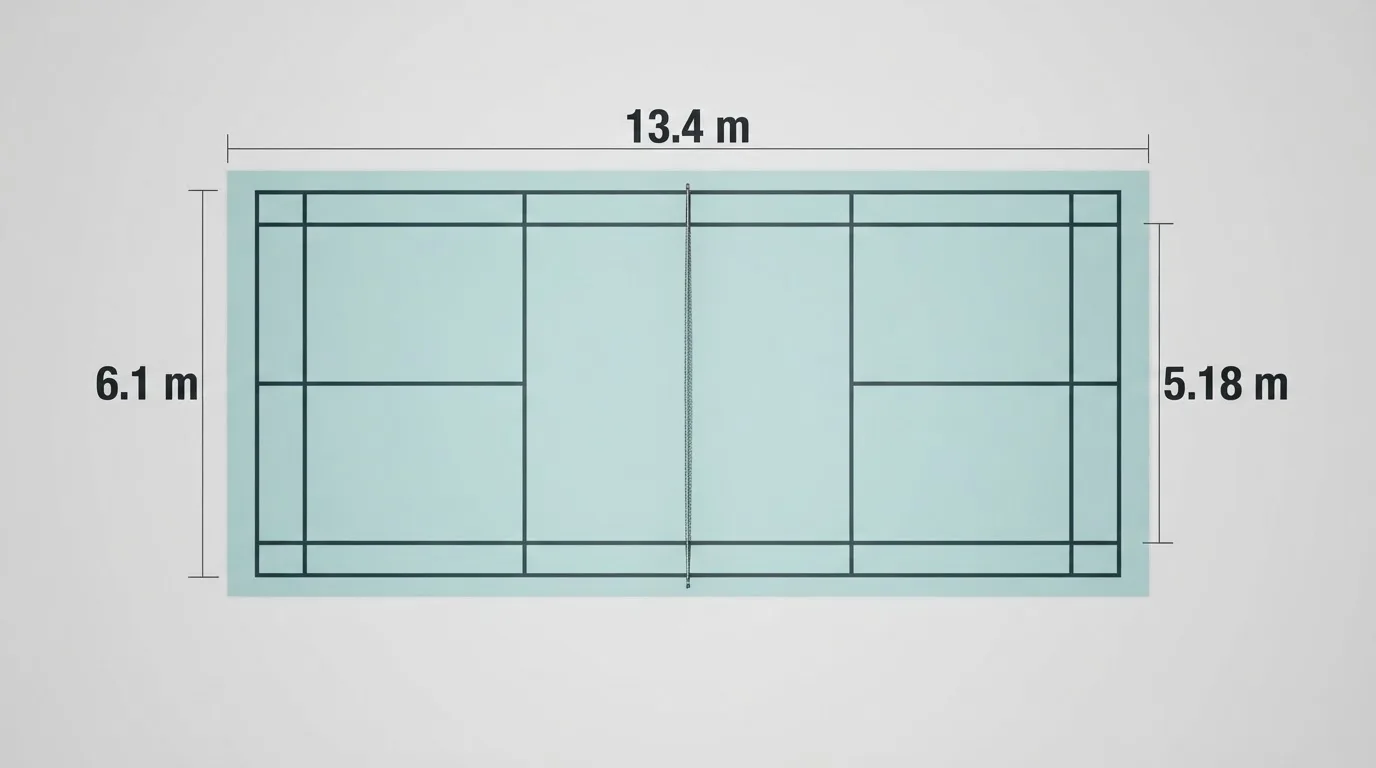
The court is 13.4 metres long. For doubles it is 6.1 metres wide; for singles it is 5.18 metres wide. The net is 1.55 metres high at the edges and 1.524 metres at the centre. The narrow singles court changes the geometry of the game compared with doubles and is the reason the same player can look like a different competitor across disciplines.
The shuttle’s flight is the technical quirk of the sport. A shuttle decelerates faster than any ball used in major racquet sports, which compresses the time a player has to react. Elite players spend years training the reflexes that a casual observer mistakes for natural talent. The punter’s takeaway: a player returning from injury who has not played for several weeks is at a greater disadvantage than the same absence would create in tennis or table tennis, and a price that has not yet adjusted to the layoff is worth checking.
Why the surface does not change the market
Unlike tennis or football, badminton is played indoors on a court of fixed dimensions. There is no clay-versus-grass distinction, no weather factor, no altitude issue at the venues where the World Tour operates. The home advantage is real but smaller than in most sports: the local player knows the venue, but the venue is the same venue for both players, and the shuttle behaves the same way. The market reflects this in relatively tight spreads between players of similar ranking; the wider spreads in the badminton market come from the gap in ranking rather than from venue effects.
Regulation, the Gambling Commission and the law
Badminton betting in Great Britain runs under the Gambling Act 2005, with the Gambling Commission as the regulator. Since the Gambling (Licensing and Advertising) Act 2014, an operator whose remote facilities are used in Great Britain needs a Commission licence wherever the operator is based. A Curaçao, Maltese or Gibraltar licence is not a substitute: a brand can hold any number of overseas licences and still need a GB one to take GB customers. The Commission’s public register is the test: it can be searched by business name, trading name, domain or account number, and a brand on the register is licensed; a brand not on it is not.
The Commission’s licence categories for the remote market are general betting standard (real events), general betting standard (virtual events), general betting limited, pool betting and betting intermediary. The latter is the licence for betting exchanges and is the category Smarkets holds. Spread betting on financial products is regulated by the Financial Conduct Authority, not the Commission, and that is the regime Spreadex operates under for its spread-betting product. Spreadex’s fixed-odds sportsbook runs under the Commission licence separately.
Northern Ireland sits outside the Gambling Act 2005 and has its own older law. A GB licence does not regulate Northern Ireland, and any brand offering services there needs the appropriate local authorisation separately. A punter in Northern Ireland should check the local position before assuming a GB-licensed brand’s services are available to them.
Identity verification is mandatory under LCCP condition 3.4.4 and related rules. Name, address and date of birth are verified before a customer can deposit or gamble — including with a free bet or bonus — and the verification has applied since 7 May 2019. There is no anonymous play at a licensed site, and a punter who wants to bet on badminton without verification is, by definition, betting outside the licensed market.
The minimum age
The minimum age for gambling in Great Britain is 18. Marketing to under-18s is banned under the CAP Code, and no one who is or seems to be under 25 may be featured gambling in an advertisement, with limited exceptions. The rule concerns who may appear in the advertisement; it is not a rule about who may bet. The licensed operators in the surveyed set all run age verification at registration.
Advertising, sponsorships and the bonus cap
Advertising is not licensed by the Commission. It runs through the CAP Code (non-broadcast) and BCAP Code (broadcast), enforced by the ASA. The LCCP marketing conditions sit on top of the CAP Code for licensed operators, and the Commission can take licence action against an operator whose advertising breaches the social responsibility code. From 19 January 2026 the promotion rules cap wagering requirements on bonuses at 10x and ban mixed-product promotions (an offer that requires gambling on two or more product types such as betting, casino, bingo and lottery). The cap on free bets with no wagering condition, and any cap on the money value of a bonus, are not established in the same rules, and the surveyed offers fall under the cap or carry no wagering at all.
The Premier League clubs’ voluntary withdrawal of gambling sponsorship from the front of matchday shirts (from 2026/27; sleeves and hoardings remain) is a sector-wide decision by the clubs, not a statutory rule, and it does not directly affect badminton betting. It is mentioned only because it is the kind of voluntary code a reader of the British sports-betting press will encounter alongside the statutory rules.
What may be bet on
There is no statutory list of permitted bets or markets. An operator holds a licence for a category and offers markets under its own rules and the LCCP. Badminton falls under “real events” and is offered by every licensed bookmaker in the surveyed set. In-play betting on badminton is offered at the larger brands and is governed by the operator’s licence conditions and customer-protection duties; it is not legally “unrestricted”, and a punter who experiences a problem with in-play settlement has the Commission’s complaints route. Esports are treated like any other event under the licence; politics, TV shows and novelty markets are offered by GB bookmakers under the same framework. No statutory cap on stakes in sports betting was found: operators set their own maximum stakes and may restrict individual customers.
Tax
The player pays no tax on betting winnings in Great Britain. General Betting Duty is the operator’s tax on gross profits, currently 15%; from 1 April 2027 a new remote betting rate of 25% applies within it, while remote bets on UK horse racing, bets on self-service betting terminals in licensed premises, pool betting and in-person betting stay at 15%. Whether operators pass duty on through odds is not established, and the player is not charged duty. The Commission’s statutory levy is a separate charge on operators and is not a tax on customers. Spread betting has its own rates (3% financial, 10% other).
Responsible gambling and the limits of self-control
GAMSTOP is the national multi-operator online self-exclusion scheme and is a mandatory licence condition for online operators since 31 March 2020. Self-exclusion periods are six months, one year, five years, or five years with auto-renewal. After the minimum period the exclusion stays in place for a further seven years unless the customer asks GAMSTOP to remove it. GAMSTOP covers online sites and apps; betting shops use a separate service. Every brand in the surveyed set is a GAMSTOP member, and signing up with one brand excludes the customer from all of them.
A financial vulnerability check has applied under LCCP condition 3.4.4 since 30 August 2024 to licensed remote betting when a customer’s deposits minus withdrawals exceed £150 in a rolling 30 days. The check has applied since 28 February 2025. It is a public-record check (bankruptcy or county court judgments, for example), not an income check and not a credit reference check. Financial risk assessments — the “affordability checks” of the press — are announced in a staged plan, with no start date as of the data snapshot; the regulatory wording is “announced, staged, no start date”.
Deposit limits are a customer-set control: the customer chooses a gross deposit limit on a fixed time frame, and the operator must offer the facility. Remote Technical Standard 12 sets the standard, and the first changes have applied since 31 October 2025. A second phase was postponed to 30 September 2026, and whether it is live is not established at the snapshot. There is no state-set deposit or loss ceiling for betting; limits are the customer’s choice.
Help services in Great Britain include GamCare (which runs the National Gambling Helpline), GambleAware, NHS gambling clinics, and Gamblers Anonymous. Fitzwilliam Sports’ home page links directly to GambleAware, GamStop and Gamblers Anonymous, which is the standard layout for a licensed UK operator. A punter who feels their betting is moving beyond their control can self-exclude via GAMSTOP, set a deposit limit with any operator, or contact GamCare for confidential support.
The unlicensed market and what it costs the punter
Providing gambling facilities in Great Britain without the licence the Act requires is an offence under section 33 of the Gambling Act 2005. The offence is aimed at the operator, not the customer. No offence aimed at a customer who merely bets on an unlicensed site was found in the framework. The cost of betting unlicensed is the loss of protection: no GAMSTOP coverage, no Commission complaints route, no approved dispute-resolution body, no British consumer redress if funds are withheld, and not bound by the 10x bonus cap or the £150 vulnerability check. The licensed alternative carries its own constraints — identity verification before the first bet, deposit limits, age checks — and the choice is between two regimes with different protections, not between a “safe” and an “unsafe” option by default.
Enforcement against unlicensed operators is disruption rather than blocking: cease-and-desist notices, search-engine referrals, work with registrars, hosts and payment providers, and the Commission’s stated intention to obtain court-order DNS blocking powers. ISP blocking is not in operation; describing it as such overstates the present position.
Worked example: what the margin looks like in the odds
A two-way market at decimal odds of 1.90 and 1.90 — the favourite and the outsider priced the same — is a clean example of an even-money book. The implied probabilities, before any margin, would be 1 ÷ 1.90 = 0.5263 (52.63%) for each side. The two probabilities add to 1.0526, or 105.26% of one unit staked. That 5.26 percentage points above 100% is the margin: the share of every unit staked the bookmaker keeps on average across the two outcomes, before any other adjustments. The corresponding payout share is 1 ÷ 1.0526 = 0.9500, or 95.00%.
A punter backing either side at random returns 95p for every £1 staked across the two outcomes on average. The other 5p is the bookmaker’s gross margin before operating costs, and that is the figure every odds comparison is built on. A real badminton match rarely prices at 1.90 / 1.90 because one player is almost always the favourite, and a price of 1.20 / 4.50 implies a margin of 1 ÷ (1 ÷ 1.20 + 1 ÷ 4.50) − 1 = 1 ÷ (0.8333 + 0.2222) − 1 = 1 ÷ 1.0556 − 1 ≈ 5.27%. The margin on the real price is, in this example, similar to the margin on the even-money price, because bookmakers work to a target margin per market and adjust the prices around that target rather than the other way round.
The take-away from the calculation: the margin is the difference between the sum of the implied probabilities and 100%, and it sits inside every price on every market at every bookmaker. A punter who wants the tightest prices compares margins across bookmakers on the same market, and the comparison is the only durable edge the customer has in the long run.
What the margin means in pounds on a real bet
A punter who stakes £10 on a match winner at 1.90 returns £19 if the bet wins — a £9 profit — and loses £10 if it does not. Across a sample of bets at a 5% margin, the average cost per £10 stake is 50p, and that is the long-run cost of betting on a market at that margin. A punter who bets at a 7% margin pays 70p per £10 stake on average, and the difference is the long-run value of choosing one bookmaker over another at the same price.
The calculation is statistical, not a guarantee: any single bet wins or loses on its own result, and the margin is the average across a large sample. A punter who wins on their first ten bets has not disproved the margin; a punter who loses on their first ten has not proved the bookmaker is “out to get them”. The margin is what the math expects in the long run, and the long run is longer than a single punter’s history.
Free-bet value in working numbers
A free bet whose stake is not paid back is worth less than its face value. The value depends on the odds at which it is staked and the margin of the market it is staked on. The standard formula is: free-bet value = free-bet amount × (odds − 1) ÷ odds × payout share of that market.
A £10 free bet at decimal odds 3.00 on a market with a 95% payout share is worth £10 × (3.00 − 1) ÷ 3.00 × 0.95 = £10 × 0.6667 × 0.95 = £6.33. The free bet pays £20 if it wins (the £10 profit), and the punter does not get the £10 stake back, so the expected value over a large sample is £6.33 — well below the £10 face value. The £3.67 difference is the cost of the free bet not paying back its stake.
At odds of 1.50, the same £10 free bet is worth £10 × (1.50 − 1) ÷ 1.50 × 0.95 = £3.17. At odds of 10.00, the same £10 free bet is worth £10 × (10.00 − 1) ÷ 10.00 × 0.95 = £8.55. The free bet’s expected value rises with the odds at which it is staked, which is the reason the marketing for a “£30 free bet” often steers the punter toward long-odds accumulators: the bookmaker’s expected cost of the free bet is higher at longer odds, but the headline value to the punter is also higher. The arithmetic the punter has to do is the same in either case.
The practical implication: a free bet is best staked at the longest odds the punter is comfortable with, on a market the punter has a view on. Staking a free bet at 1.20 on the favourite is leaving most of the value on the table; staking it at 6.00 on a competitive player brings the expected value much closer to the face figure. That is the one piece of arithmetic the marketing rarely says out loud.
What a welcome offer is really worth
A “£40 in free bets” welcome offer at minimum qualifying odds of 2.0 is worth, in expected terms, less than £40. The free bets themselves carry the stake-not-returned property described above; the qualifying bet is a stake the punter has to place at minimum odds of 2.0 (which carries its own margin cost); the 7-day expiry creates a real risk of forfeiture for any punter who does not place the free bets in time. The net expected value of a £40 free bet welcome at minimum odds of 2.0, staked at a market with 95% payout share, is around £40 × 0.50 × 0.95 = £19, before the cost of the qualifying bet. The punter who accepts a welcome offer is buying an expected value, not a guaranteed £40, and the expected value is the figure they should weigh against the alternative of betting without the welcome.
Choosing a bookmaker for badminton
The honest answer is that the GB-licensed market for badminton is served well enough by any of the larger brands, and the differences between them are mostly in the welcome offer, the in-play infrastructure and the depth of the player-prop markets rather than in the headline price. bet365’s in-play and live-streaming infrastructure makes it the strongest generalist for a punter who follows badminton specifically; Unibet’s welcome offer and long operating history make it the strongest choice for a punter who wants a serious welcome and is happy to bet on the sport’s marquee events. Smarkets’ exchange is worth checking on the major tournaments as a price-check against the fixed-odds book.
For a punter who already holds an account with one of the smaller brands — Kalooki Sportsbook, Fitzwilliam Sports, London.bet — the case for opening a second account is the depth of the in-play and prop markets at the larger brands. For a punter who does not yet hold any account, the starting point is the brand that pairs a useful welcome offer with the sportsbook depth they intend to use, and that calculation is the same for badminton as for any other sport on the same platform.
The choice that matters more than the brand is the market. A punter who bets only on match winners is paying the smallest margin and getting the most predictable settlement; a punter who bets heavily on accumulators is paying a stacked margin at each leg and getting the worst of the margin-plus-payout math. The market decision is the punter’s, and the brand decision follows from it.
A short practical guide
Open an account with one of the larger brands for the welcome offer and the in-play depth. Hold a second account with a betting exchange for price comparison on the major events. Set a deposit limit at registration, before the first bet, and stick to it. Use GAMSTOP if the deposit limit is not enough. Read the wagering terms on any free bet before placing the qualifying bet, and stake the free bet at the longest odds the punter is comfortable with on a market they have a view on.
The four-step shape is simple, and most of it is the kind of thing a seasoned punter does by default. The point of writing it out is that the punter who skips a step is the punter who pays for it later: a punter who does not set a deposit limit at registration is a punter who will set one after a losing streak, when it is too late to do any good. The discipline is in the order, not in any single decision.
The shortlist in closing
Ten brands, all GB-licensed, all GAMSTOP members. The ones that earn their place on a badminton-specific shortlist are bet365 for the in-play infrastructure, Unibet for the welcome offer, and Smarkets for the price-check on the major events. The others are useful second accounts or a place to land when a fixture is not priced elsewhere. None of them is the only choice, and none of them is the safe choice by default: the safe choice, in this market, is the one the punter has set a deposit limit on before the first bet and reads the wagering terms before claiming the welcome.
The badminton calendar runs through the year and the World Tour keeps the fixtures coming. The markets on offer are standard, the welcome offers are standard, and the rules of the sport are stable. The punter’s job is the same job it has always been: pick a market, set a stake, place the bet, and read the T&Cs.
Frequently asked questions
How is a bet on badminton actually placed at a UK bookmaker?
A punter registers with a GB-licensed bookmaker, completes the identity verification (name, address, date of birth — checked against public records before the first deposit), deposits by debit card or bank transfer (credit cards are banned for gambling in Great Britain), and selects the badminton event from the sportsbook. The match winner is the standard market; set betting, game handicap and total games are offered at the larger brands. The bet is settled after the match finishes, with in-play bets settled continuously as the match progresses. Withdrawals are paid back to the original deposit method under standard anti-money-laundering rules.
How is it checked that a bookmaker holds a Gambling Commission licence?
The Commission’s public register at the regulator’s own site can be searched by business name, trading name, domain or account number. A brand on the register, against a valid licence under one of the remote categories, is licensed for Great Britain. The licence holder is the named company on the register; the brand is the trading name under that licence. Several brands can run under one licence holder, and a brand on the register is not, by that fact, recommended by the regulator — it is licensed, not endorsed.
How is the return on a bet worked out from the stake and the odds?
For a single bet at decimal odds O and stake S, a winning bet returns S × O, of which the profit is S × (O − 1) and the stake comes back as part of the return. A losing bet returns zero. For a combination bet the odds multiply into one combined price, and all selections must win for the bet to pay. Each-way betting doubles the stake (one bet to win, one bet to place) and pays the place fraction if the selection places but does not win.
What is the bookmaker’s margin and how is it visible in the odds?
The margin is the share of every unit staked that the bookmaker keeps on average across all outcomes of a market. It is calculated from the sum of the implied probabilities of the prices offered: the overround is that sum minus 1, and the margin is the overround divided by the sum. An even-money two-way market at 1.90 / 1.90 implies 0.5263 + 0.5263 = 1.0526, an overround of 5.26% and a margin of 5.0%. A market with a margin of 5% returns 95p per £1 staked on average; the remaining 5p is the bookmaker’s gross take.
How do fractional odds such as 5/1 convert to decimal odds such as 6.00?
Fractional odds a/b convert to decimal odds (a ÷ b) + 1. So 5/1 becomes (5 ÷ 1) + 1 = 6.00, 11/4 becomes (11 ÷ 4) + 1 = 2.75 + 1 = 3.75, and evens (1/1) becomes 2.00. The decimal odds include the stake in the return, while the fractional odds do not — a £10 stake at 5/1 returns £60 (£50 profit plus the £10 stake), and £10 at 6.00 returns £60 (£50 profit plus the £10 stake), the same result.
Which tools for controlling play does a licensed bookmaker have to offer?
GAMSTOP self-exclusion (six months to five years plus a seven-year tail) is mandatory for online operators. Deposit limits (gross, fixed time frame) are a customer-set control under RTS 12. Timeouts (cooling-off periods), reality checks and session timers are operator-set controls under the LCCP social responsibility code. A financial vulnerability check applies when a customer’s deposits minus withdrawals exceed £150 in a rolling 30 days, and is a public-record check, not an income check. Self-exclusion via GAMSTOP, deposit limits with any operator, and GamCare for confidential support are the three durable controls a punter can use.
Tennis, darts & cue sports – Rugbytipsters.com
Content created by the «Rugbytipsters.com» team
