Chess Betting Odds in Great Britain: How Prices Work and Where to Bet
 Available in US
The numbers beside a chess market are not a forecast. They are a price — what the bookmaker will pay you for each pound you stake if your selection wins. Understanding what sits inside that price, and what it costs you to take it, is the difference between reading odds and using them. This guide walks through how chess betting odds are built, which markets licensed bookmakers actually offer, and what the choice between them looks like for a punter placing a bet today.
Current as of October 30, 2026 · Operator licensing verified against the Gambling Commission’s public register.
Chess Betting Apps and Mobile Access
The chess calendar rarely waits for a desktop. Candidates and Grand Prix legs run in time zones that favour a handset rather than a desk, and the punter checking lines between meetings wants an app that loads the in-play board without a fight. Every bookmaker listed on the Gambling Commission’s public register runs an app alongside its main site, so the question is not who offers one but which one behaves well on your phone.
Three things separate a workable chess betting app from a slow one. The first is the depth of the in-play menu: chess moves at a different pace from football, and an app that forces a full reload between moves is one a punter closes in frustration. The second is how the bet slip handles combination bets on a small screen — building a four-leg tournament acca with an accumulator bonus applied mid-selection is fiddly on a cramped layout. The third is whether the app surfaces live clocks and standings without digging into a sub-menu, because picking Magnus Carlsen to draw in 40 moves is a different decision when you can see his clock at thirty seconds.
The downside of an app-first workflow is the same as it is everywhere else in the trade: push notifications that move during play, deposit prompts placed one tap away from the bet slip, and bonus banners that lead with “free” and bury the conditions two scrolls down. A punter who treats the app as a tool rather than a feed keeps those in proportion. The Gambling Commission’s identity check happens before the first deposit, so the verification flow cannot be skipped by going mobile-only — that holds whoever you bet with, whoever holds the licence.
Browser access still exists on every licensed site, and for chess specifically the browser view is often easier on a tablet than the phone app, because longer tournament names and player pairings read better at a tablet width. Two apps are commonly named in this category as the most downloaded for sports betting in the UK, and both keep browser parity at the same URL — useful for punters who want a bigger board view without losing the bet slip they already built.
Live Betting and Cash Out on Chess
Live chess betting is unusual among in-play markets. Football sees a goal and the price moves in a second; cricket moves on the fall of a wicket. Chess moves on increments so small that the board state itself is the trigger — a capture, a passed pawn, a king march that turns a closed position into a lost one. The in-play page on a licensed bookmaker therefore looks calmer than an in-play football page, but the prices still move, and on a long game the drift can run for hours.

Cash out on a chess market is the bookmaker offering to buy your bet back from you before the game has finished. The price is its model of what the position is worth right now, less a margin that is the cost of certainty. On a level game between two titled players the cash-out value can sit very close to your stake for most of the game and then collapse on a single decisive move — the moment a real edge disappears is the same moment the cash-out window starts to look attractive, and the bookmaker knows that. Punters who want to use it should understand that the implied margin inside the cash-out value is wider than the margin on the same market pre-match.
In-play betting on chess is offered by GB-licensed bookmakers under their own licence conditions and customer-protection duties; it is not a separate licence category. The controls are the operator’s, and they vary. Some books keep every chess market live for the full length of the game; others suspend the match winner market on a critical pawn advance and reopen it when the board looks stable. Both are licensed behaviour. The advice that holds is the same one that holds on every in-play market: do not chase a position you did not price before the game started, and do not cash out a bet you would have placed again at the same odds.
A specific chess format changes the rhythm of in-play betting. A rapid game finishes in fifteen minutes per side and the whole in-play sequence runs inside an hour; a classical game can run for five hours and the cash-out value can move through five bands. Bullet chess at sixty seconds per side is so short that pre-match and in-play overlap. Punters who prefer classical chess should expect a slow in-play market; those who watch the Speed Chess Championship should expect a near-pre-match rhythm.
Chess Betting Predictions, Analysis and Strategy
Every article that promises chess betting tips is selling a forecast, and the forecast is the one thing no outsider can verify. Gukesh Dommaraju won the world title in 2024 and that result was not in any model’s price before the game started; a betting strategy built on predicting the next champion is a strategy built on something nobody can know. What a chess betting strategy can do is reduce the number of bets that lose on conditions the punter did not read, and that is a smaller, more honest claim.
The first strategy is the bankroll: a fixed stake as a percentage of the betting fund, never a percentage of a recent win. The second is selection: the market that the punter knows. Chess opens dozens of side markets — total games in the match, first blood, draw odds on individual games, handicap on the rating gap — and most punters are well served by sticking to one or two. The third is timing: lines move in the days before a tournament, after the pairings are drawn, and again after the first game, and the price you take at each moment reflects information the market has already absorbed. None of this predicts the winner. It controls the cost of being wrong.
A common gambler’s fallacy on chess is the favourite-longshot bias in reverse. Top board players are heavy favourites to win individual games, and the price on the underdog is wide; the price on the favourite looks short. Short prices are not bad prices if the margin inside them is small and the probability is genuinely high. The mistake is to read a short price as a sure thing and stake more than the edge supports. A winning strategy on chess is a sequence of small edges compounded over a season, not a single large bet on a tournament preview.
Analysis on chess betting, in the sense that matters, is the kind a punter does before the game rather than the kind a tipster sells the morning of. Engine evaluations are public once a game is over; before it, the market is pricing uncertainty rather than outcome. Punters who treat chess betting as a research project — collecting the live rating gap, the head-to-head, the colour sequence, the form at classical time controls — make better decisions than punters who treat it as a tipsters’ market. They also make fewer of them, which is the point.
Chess Betting Markets: Match, Game, Side Bets and Combinations
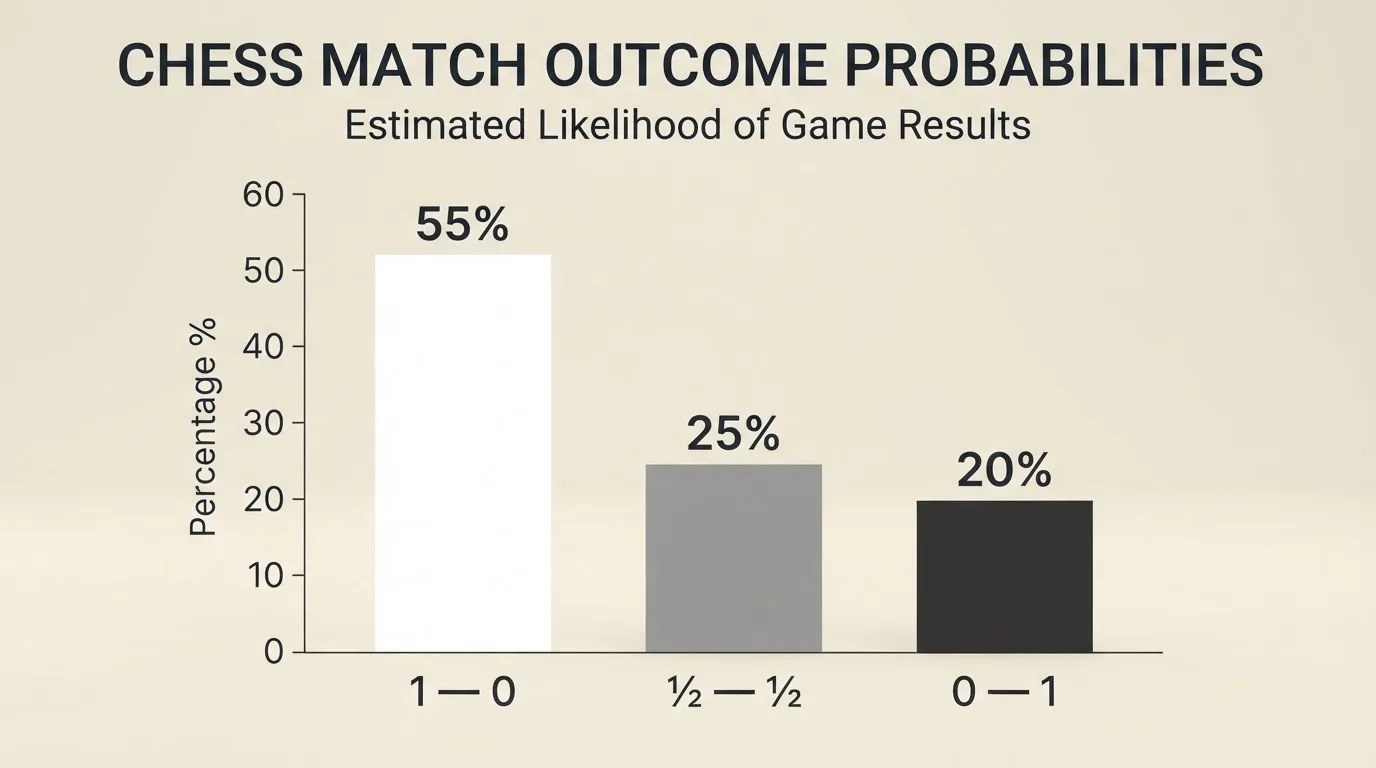
A chess betting market is the question a punter is asking the bookmaker to settle. The most basic is the match winner: White, Draw, Black — three outcomes, two of them identical in pure chess because the draw is so common. Chess results are recorded as 1–0 for a White win, 0–1 for a Black win and ½–½ for a draw, and a three-way match market reflects that. The draw is the structural feature of chess betting — most games at the top level end without a decisive result, and a punter who ignores it is reading a price for a market that resolves differently from how football does.
Two-way markets exist where one outcome is structurally rare or impossible. A game between Magnus Carlsen and a player 300 Elo below him has a near-zero draw probability because the favourite will press for a win; the bookmaker prices it as a two-way market and the margin is calculated across two outcomes instead of three. The illustration below uses a two-way even-money line (1.90 / 1.90, fractional 9/10) as the example, because it is the clearest case to reason about.
Match score markets ask how the match as a whole ends. Best-of-N games, total match points, leading after game K — these are popular where the format has been published in advance. Candidates matches are scheduled as best-of-14 games and the draw at match level is unusual; a World Championship tiebreak is rarer still. Markets on individual games within a match — game one, game two, draw on each — are widely offered during the Candidates and the World Championship and are where most of the in-play turnover sits.
Game-level side markets include first blood (the first decisive game of the match), total games over or under a published line, and the colour advantage in the next game. Handicaps in chess work on the rating gap rather than a goal start: a punt on Black with a +1 game handicap means Black needs only to draw the match at level, the bet is the underdog choice at near-even money. Each-way betting does not exist on chess — it is a horse-racing construct — and punters who see it offered are looking at an offer that has been carried over from another sport or a misuse of vocabulary.
Combination bets, or accumulators, multiply the odds of the legs into one price. A four-leg acca at 2.00, 2.00, 2.00 and 2.00 reads as 16.00 because each leg doubles the price; the margin inside an accumulator is the compounded margin of each leg, and a punter who builds accas on thin markets is paying a much wider margin than a punter who bets singles. Bet Builder products on chess combine markets from one event — match winner plus total games over, draw on game one plus White to win the match — and the price is a single number the bookmaker quotes. The implied margin inside a Bet Builder is wider than inside the singles that make it up, and the punter should treat it as a separate market with its own number.
How the Bookmaker’s Margin Sits Inside the Odds
The margin is the slice of every pound staked that the bookmaker keeps, on average, across all outcomes of a market. It is not a fee, it is not a cut, it is the difference between the true probabilities and the prices offered. Calculating it is arithmetic on the implied probabilities of the odds.
A two-way market priced at 1.90 / 1.90 implies 1 ÷ 1.90 + 1 ÷ 1.90 = 0.5263 + 0.5263 = 1.0526, so the payout share the bookmaker returns across both outcomes is 1 ÷ 1.0526 = 95.00% and the margin is 5.00%. A three-way chess match market priced at 1.70 / 4.50 / 2.80 implies 0.5882 + 0.2222 + 0.3571 = 1.1675, payout share 85.65%, margin 14.35%. The three-way line carries the wider margin because the draw makes bookmaker pricing harder; the two-way even-money line is the cleanest illustration a punter will meet.
A useful working rule for chess: a tight two-way line sits in a 4–6% margin band, a three-way match winner on a top-level event sits in a 6–10% margin band, and a Bet Builder or acca on chess sits wider again because its margin compounds. These are bands of the kind most published in trade analysis; the actual figure for a given market depends on the bookmaker and the time. Where the bookmaker’s price on the draw in a top-level match winner drops to a small implied probability, the margin inflates because the other two outcomes must over-cover it.
The punter’s read is simple: every price already carries its margin, two prices on the same market differ by their margin and not by their forecast, and a margin inside a Bet Builder is wider than a margin on either single. Comparing two bookmakers on the same fixture is a comparison of margins, not of opinions about who wins. That is what the numbers on the page actually show.
Chess Tournaments Worth Betting On
Chess betting follows the tournament calendar. The two pinnacles are the World Chess Championship and the Candidates Tournament that decides its challenger; behind them sit the Grand Prix series, the Norway Chess and Tata Steel invitations, the speed and rapid championships, and a busy online circuit at Chess.com and Lichess. Betting turnover on chess concentrates on the events the bookmakers have priced — and bookmakers price the events their customers ask about, which is itself a feedback loop.
Wilhelm Steinitz claimed the first universally recognised World Chess Championship in 1886, and the title has changed hands through the classical era into the modern era. The modern world championship runs as a long classical match; the modern Candidates is the qualifying tournament, held every two years in the cycle. These two events carry the deepest markets, the longest in-play coverage and the most attention from affiliates. Smaller events carry fewer markets but the structure is the same: pre-match winner, three-way or two-way, side markets on individual games, in-play coverage on the marquee boards.
FIDE (the International Chess Federation) is the world governing body and publishes the rules in its Handbook. The rules matter to a bettor because they decide what happens at the end of a drawn position: a game is drawn by stalemate, by agreement between the players, or by claim of threefold repetition or the fifty-move rule; since 2014, fivefold repetition and a 75-move rule end the game automatically. A bettor pricing a “draw at move 60” market needs to know that the fifty-move rule kicks in at 50 moves without a capture or pawn move, and that the auto-end at 75 has closed most of those bets since the rule change.
Online chess is a separate betting universe. The Chess.com site runs its own titled events, the Speed Chess Championship and a CCL (the Champions Chess Tour run by the Chess.com site) that bookmakers have started to price. Lichess runs community events that licensed UK bookmakers do not generally cover. The markets that sit on online chess are limited because the books cannot verify the integrity of the games inside their own data feeds; that is a feature of the market, not a quirk of a single brand. Punters who want to bet on online chess usually find a thinner menu than on classical over-the-board play.
Esports and virtual chess sit in a different licence category under the Commission’s own classification: virtual events are a separate remote licence type and not every bookmaker holds one. A punter who sees a “chess simulator” listed at a sportsbook should check what licence category it sits under, not because it is illegal but because the betting mechanics and the operator’s duties differ from real events.
The Ten Chess Betting Sites Reviewed
This review is built around ten GB-licensed bookmakers that operate in this market, paired with what they bring to a chess punter’s shortlist. The list is not a ranking in the sense of “from best to worst”. It is a shortlist of brands the Commission has on its public register against a remote general betting standard (real events) licence, ordered from the broadest chess offer to one built around a smaller event calendar. Each review covers the betting licence and holder, what the operator’s own terms say about the markets a chess punter cares about, and a verdict that answers the question a punter actually asks when choosing.
Each licence line below names the Gambling Commission account number and the licence holder as the Commission’s own register carries them, so a punter can verify it against the public register before placing a bet. The licence categories listed are the ones named on the register for that business; several brands can sit under one licensee, and the licence is on the holder, not on the consumer-facing brand name.
| Brand | Gambling Commission remote licence number and licence holder | What the operator’s own terms state on chess |
|---|---|---|
| Betfred | Licence 039544-R-319290-010 (Commission account 39544) — remote general betting standard (real events); holder Petfre (Gibraltar) Limited | Sports app from Done Brothers (Cash Betting) Ltd covering 21 sports plus over 2,000 casino-style games; broad fixed-odds menu with price boosts and combination bet products on major chess fixtures. |
| BetMGM | Licence 039198-R-319450-029 (Commission account 39198) — remote general betting standard (real events); holder LeoVegas Gaming PLC | New-customer sports welcome that triggers on a first bet within 7 days and pays out in four £10 free bets valid 7 days, with minimum odds and an opt-in; the sportsbook carries the major chess events with full match-winner and side markets. |
| Bet600 | Licence 044731-R-323941-016 (Commission account 44731) — remote general betting standard (real events); holder Tyche Tech Limited | Best Odds Guaranteed on horse racing settles SP-vs-taken-price in the punter’s favour; the chess section prices the marquee chess events and adds in-play on the longer formats. |
| 10bet | Licence 043173-R-322899-023 (Commission account 43173) — remote general betting standard (real events); holder Blue Star Planet Limited | Sportsbook covering football, tennis and horse racing with Cash out, a Bet Builder and Live Streaming; chess fits inside a general sportsbook with in-play on the major boards. |
| DragonBet | Licence 064908-R-339041-003 (Commission account 64908) — remote general betting standard (real events); holder DragonBet Ltd | Published by DragonBet Ltd with markets in Welsh football and rugby, racing, American football, in-play and bet builder products; chess appears within the broader menu, not as the central vertical. |
| Fitzwilliam Sports | Licence 048760-R-335434-009 (Commission account 48760) — remote general betting standard (real events); holder SBKI Limited | Dublin-based bookmaker with capped membership and a “High Stakes Welcome” subject to compliance criteria; instant deposits, fast withdrawals, timeouts and deposit limits under their own safer-gambling page. |
| Bar One Racing | Licence 056516-R-332750-007 (Commission account 56516) — remote general betting standard (real events); holder Bar-One Racing Limited | Rebranded from Bar One Racing to BAR 1 Betting; Irish independent bookmaker with shops across Ireland and horse racing sponsorships at Dundalk, Fairyhouse, Navan, The Curragh, Curraheen Park and Cork. |
| Midnite | Licence 101839-R-342850-001 (Commission account 101839) — remote general betting standard (real events); holder Midnite Limited | Site cites the Commission’s licence and shows in-play events, an acca builder, popular accas and price boosts with maximum-stake limits; new-customer welcome is £25 in free bets and 50 free spins on a £5 pre-match qualifying bet at EVS or greater, valid 7 days. |
| Paddy Power | Licence 039439-R-319330-013 (Commission account 39439) — remote general betting standard (real events); holder PPB Counterparty Services Limited | App covers football, horse racing, boxing, rugby, tennis, golf, darts, snooker and F1; chess sits inside a wide fixed-odds sportsbook with the major events priced and in-play on marquee boards. |
| NetBet | Licence 039170-R-319343-032 (Commission account 39170) — remote general betting standard (real events); holder Netbet Enterprises Limited | Daily Boosts, Profit Boosts, free bet offers, a Bet Builder with instant dynamic odds and sports stats for major leagues; chess appears within the broader sportsbook with in-play where offered. |
Betfred
The Betfred licence sits on Petfre (Gibraltar) Limited at Commission account 39544 with a remote general betting standard (real events) category — exactly the licence a punter expects for a real-event sportsbook. The brand’s own app description names twenty-one sports, and the depth across each is the kind that comes from running a high-street bookmaker with a long UK presence. For a chess punter, that means depth on the major events and a price on the side markets rather than a chess-specific shop front.
The chess menu follows the calendar: full match-winner coverage of the World Championship and Candidates, game-by-game side markets, and a Betfred-style combination product on the marquee fixtures. In-play coverage on the classical matches runs the length of the game. The combination products on a Betfred acca carry the brand’s own margin, which is wider than the margin on the singles that make it up.
Verdict: A solid all-rounder that provides a single wallet for all events, ideal if you prefer to avoid jumping between different applications during a tournament.
BetMGM
BetMGM is LeoVegas Gaming PLC at Commission account 39198, and the welcome terms published on the App Store listing name a first-bet trigger (£10 minimum deposit, one sports bet within 7 days) and four £10 free bets split into two football accumulators of four-plus selections and two sports multiples of two-plus. That is the welcome, not the chess experience, and it carries the usual conditions — minimum odds, opt-in, seven-day validity.
The chess sportsbook carries the marquee events at full market depth and offers in-play on the longer classical formats. The combination products sit on the same Bet Builder-style chassis as the rest of the brand’s sportsbook. For a chess punter, BetMGM is well priced on the candidates and the World Chess Championship and offers a deeper welcome package than most of the smaller books, with the wider wagering that goes with a deeper welcome.
Verdict: A strong option for major chess tournaments, offering a more significant welcome bonus than many competitors, provided you are comfortable with the standard accompanying conditions.
Bet600
Bet600 is Tyche Tech Limited at Commission account 44731. The brand’s own material names Best Odds Guaranteed on horse racing — if the starting price is bigger than the early or show price taken, the bet pays at SP — which is a horse-racing product and not a chess product, and a punt on chess does not receive it. The chess section is priced inside a general sportsbook; the brand strengths are the broader racing offer and the payment structure.
Chess punters find the marquee events priced and a working in-play menu. The combination products sit inside the same Bet Builder chassis as the rest of the sportsbook. The narrower event coverage makes the brand a useful second book rather than a primary one for a chess-heavy punter.
Verdict: a clean secondary book for chess when a primary book is short on a market the punter wants priced.
10bet
10bet is Blue Star Planet Limited at Commission account 43173. The sportsbook covers football, tennis and horse racing with Cash out, a Bet Builder and Live Streaming, which is the modern sports chassis licensed operators run, and chess fits inside it. The Live Streaming tile is one of the brand’s known products and the deeper the streamed events list, the broader the in-play menu.
For a chess punter, 10bet’s value is the same as a Betfred or a Paddy Power — a complete sportsbook with the marquee chess events at full depth and in-play on the major boards. The Bet Builder sits inside the wider combination offer and the cash-out value is the operator’s model of the position, less a margin that is the cost of certainty.
Verdict: A sensible primary book for anyone prioritizing reliable cash-out and consistent streaming access over a dedicated chess interface.
DragonBet
DragonBet is DragonBet Ltd at Commission account 64908, a smaller bookmaker with markets in Welsh football and rugby, racing, American football, in-play and a bet builder. The chess menu inside the brand sits inside the broader sportsbook and is priced for the marquee events; the smaller event calendar fits a punter who bets on chess among other sports and does not need a single-sport deep platform.
The combination product on DragonBet is its bet builder, and the in-play menu runs on the marquee boards. For a chess-specific punter, DragonBet works as a complementary book to a wider operator rather than a stand-alone chess shop.
Verdict: a tidy complementary book for a punter who already has a primary chess book and uses DragonBet on the Welsh and racing markets.
Fitzwilliam Sports
Fitzwilliam Sports is SBKI Limited at Commission account 48760, and the brand calls itself a Dublin bookmaker with capped membership — a deliberate choice to limit the customer base and run a higher-touch service than a mass-market sportsbook. The welcome is a “High Stakes Welcome” subject to compliance criteria, which fits the membership model. Instant deposits, fast withdrawals, timeouts and deposit limits are named on the brand’s own safer-gambling page.
The chess menu on Fitzwilliam sits inside a smaller sportsbook than the high-street books and the markets priced depend on the events the brand’s customer base follows. Punters who like a smaller book and can pass the membership criteria get a quieter interface and a different customer service experience than a mass-market book.
Verdict: A suitable choice if you prefer a high-touch, exclusive membership experience, though mass-market players seeking broad event coverage may find it less convenient.
Bar One Racing
Bar One Racing is Bar-One Racing Limited at Commission account 56516, an Irish independent that has rebranded as BAR 1 Betting. The brand shops across Ireland with horse racing sponsorships at Dundalk, Fairyhouse, Navan, The Curragh, Curraheen Park and Cork — a clear racing-led identity rather than a chess-led one. The sportsbook carries the major chess events but the racing focus is the brand’s centre of gravity.
For a chess punter, BAR 1 works as a secondary book at best, useful on a specific market where the racing book happens to be priced differently. The smaller event menu makes it hard to recommend as a primary chess book, and the racing depth is genuinely impressive.
Verdict: a strong racing book that prices the major chess events; not the natural home for a chess-only punter.
Midnite
Midnite is Midnite Limited at Commission account 101839. The brand’s own site cites the Commission’s licence and lists in-play events, an acca builder, popular accas and price boosts with maximum-stake limits. The sports welcome on the App Store listing is £25 in free bets and 50 free spins on a £5 pre-match qualifying bet at EVS or greater, valid 7 days from sign-up — a specific wager-free opening relative to the standard deposit-gated welcome.
The chess sportsbook on Midnite carries the marquee events at depth and the in-play menu runs with the brand’s other sports. The combination products on the acca builder carry the brand’s wider margin. The welcome is one of the smaller deposit requirements in the review.
Verdict: An excellent, modern sportsbook option featuring a user-friendly interface, competitive welcome offer, and well-priced marquee chess markets.
Paddy Power
Paddy Power is PPB Counterparty Services Limited at Commission account 39439. The app covers football, horse racing, boxing, rugby, tennis, golf, darts, snooker and F1 — a long sports menu with chess sitting inside it as a smaller vertical. The brand’s trademark on promotion and price boosts carries through to the chess section; the in-play menu on the marquee boards is broad.
For a chess punter, Paddy Power is a major sportsbook with a side menu on chess rather than a chess book. The promotional cadence is faster than most of the small books and the price-boost products are part of the daily rhythm.
Verdict: A reliable choice for existing Paddy Power customers, though less compelling for pure chess specialists looking for deep niche markets.
NetBet
NetBet is Netbet Enterprises Limited at Commission account 39170. The sportsbook runs Daily Boosts, Profit Boosts and free bet offers, a Bet Builder with instant dynamic odds and sports stats for major leagues. The product range is the modern sports book chassis with a daily-promotion rhythm rather than a chess-led book.
The chess menu on NetBet sits inside the broader sportsbook at standard depth on the major events. The combination products use the Bet Builder chassis with the brand’s wider compounding margin. The product range is genuinely broad and the chess section is one of many.
Verdict: a sensible mid-tier primary book for a chess punter, with a stronger daily promotion cadence than a typical mid-tier book at the cost of a slightly wider margin on the daily boosts.
What Chess Betting Looks Like in Great Britain
Chess sits inside the general betting regime in Great Britain — there is no statutory list of permitted sports, and no separate chess licence. A bookmaker serving customers in Great Britain needs a Commission licence wherever it is based; the Commission’s public register is the whole test of who holds one, and every operator detail a punter cares about comes from that operator’s own terms. The implication is that a chess punter is shopping the same licensed sportsbooks everyone else is, and the only chess-specific question is whether a brand prices the fixture and at what depth.
What a bookmaker offers on chess is therefore a market choice, not a regime choice. The bigger sportsbooks carry the marquee chess events at depth; the smaller books carry the same events at less depth; the racing-led books carry the World Chess Championship at full depth because it is the only chess event the cycling matters for. No bookmaker has exclusive access to chess; no licence separates one bookmaker from another on the sport. The chess section is a vertical on a sportsbook, just as darts or snooker is, and the punter’s choice between books is the same choice on every sport: licence, depth, margin and welcome.
The Spreadex business exists on the other side of the same regime: financial spread betting is regulated by the Financial Conduct Authority, and Spreadex is regulated by the FCA for spread betting and by the Gambling Commission for fixed-odds betting; the brand’s own material states that spread betting losses can exceed the deposit. A punter choosing between a fixed-odds chess bet at a GB sportsbook and a spread bet on the same fixture at a financial bookmaker is choosing between two regimes, and the FCA’s regime is the one where losses can exceed the stake. That is a separate article’s subject; the headline is that it sits one click away from the same chess market if a punter is not careful.
A chess punter in Great Britain is treated, for tax purposes, like every other punter on a licensed sportsbook. The player pays no tax on betting winnings in Great Britain, and the duty sits with the operator — General Betting Duty is the operator’s tax on gross profits, currently 15%. From 1 April 2027 a new remote betting rate of 25% applies within it; that is an operator-side change and is not a punters’ tax. Whether operators pass duty on through tighter odds is a question that will be answered by the market and not by the regulator.
Regulation, Advertising and the Bonus Cap
The Gambling Commission licenses the whole commercial market under the Gambling Act 2005, which covers Great Britain (England, Scotland and Wales); Northern Ireland sits outside the Act and has its own older law, so a “GB licence” is exactly that and does not reach Northern Ireland. Since the Gambling (Licensing and Advertising) Act 2014 an operator whose remote facilities are used in Great Britain needs a Commission licence wherever it is based, and a Curaçao, Maltese or Gibraltar licence is not a substitute. Sections 33 and 36 of the 2005 Act as amended are the relevant provisions, and the penalty for providing gambling facilities in Great Britain without the licence the Act requires is on the operator — the offences are summary conviction penalties up to 51 weeks’ imprisonment and a fine up to level 5, or both (six months in Scotland). The Commission has been given, or is about to receive, court-order DNS blocking powers aimed at the offshore unlicensed market, but enforcement is disruption rather than blocking: cease-and-desist notices, search-engine referrals and work with registrars, hosts and payment providers. Punters cannot rely on ISP blocking.
Wagering requirements on bonuses are capped at 10x since 19 January 2026 — a £10 bonus at 50x needs £500 of bets; under the cap no more than £100. Mixed-product promotions — an offer that requires gambling on two or more product types such as betting, casino, bingo and lottery — are banned under the same rule set. Whether the cap applies to free bets with no wagering condition, and any cap on the money value of a bonus, are not established; punters should read the offer terms and not assume the cap covers everything that looks like a promotion.
Marketing is not licensed by the Commission; it runs through the CAP Code (non-broadcast) and BCAP Code (broadcast), enforced by the ASA, alongside the LCCP marketing conditions. CAP Code section 16 governs the socially responsible presentation of gambling advertising: marketing must not be of strong appeal to under-18s, and no one who is or seems to be under 25 may be featured gambling or play a significant role in a gambling advertisement (with an exception for marketing placed in the location where a bet can be made). That rule concerns who may appear in an advertisement, not who may bet. “Whistle-to-whistle” — the rule that no betting advertisements are shown on TV from five minutes before a live sporting event to five minutes after it, before the 9pm watershed (horse and greyhound racing excluded) — is an industry code that has applied since 1 August 2019, not a statute. The Premier League clubs’ voluntary withdrawal of gambling sponsorship from the front of matchday shirts from 2026/27 is voluntary, not law; sleeves and hoardings remain.
Safer Gambling in the UK
GAMSTOP is the national multi-operator online self-exclusion scheme and a mandatory licence condition for online operators since 31 March 2020. Exclusion periods are six months, one year, five years, or five years with auto-renewal; after the minimum period the exclusion stays in place for a further seven years unless the customer asks GAMSTOP to remove it. GAMSTOP covers online sites and apps; betting shops use a separate service. Every GB-licensed online operator takes part in GAMSTOP, so a punters’ exclusion applies across the licensed market at once.
Identity verification is mandatory before a customer’s first deposit, under rules in force since 7 May 2019 — name, address and date of birth are checked, including where a free bet or bonus is being claimed. There is no anonymous play at a licensed site. The Kalooki Sportsbook card in research carries the same verification flow as a generic brand name, and the GAMSTOP membership is on the same register entry; this is the licensed-bookmaker baseline and not a special chess rule.
A financial vulnerability check (LCCP condition 3.4.4) has applied to licensed remote betting since 30 August 2024 when a customer’s deposits minus withdrawals exceed £150 in a rolling 30 days (in force since 28 February 2025). It is a public-record check (for example bankruptcy or county court judgments), not an income check and not a credit reference check. Financial risk assessments — the “affordability checks” of the press — have been announced in a staged plan, with no start date, and a punters’ immediate experience at most licensed books is the vulnerability check rather than a full affordability check. There is no state-set deposit or loss ceiling for betting in Great Britain; deposit limits are the customer’s choice and operators must offer a fixed-time-frame gross deposit limit under RTS 12.
Help exists for a punter who needs it. GamCare runs the National Gambling Helpline; GambleAware funds treatment and education; the NHS runs gambling clinics in regions across England; Gamblers Anonymous runs mutual-support meetings. The Fitzwilliam page links to GambleAware, GAMSTOP and Gamblers Anonymous as its own safer-gambling resources — a single example of what every licensed bookmaker’s safer-gambling page should carry. Operators are responsible for the marketing of their affiliates, and a punter who feels an affiliate has crossed the line can complain to the operator and, ultimately, to an approved alternative dispute resolution body.
Credit cards are banned for gambling in Great Britain under LCCP condition 6.1.2 since 14 April 2020, including credit-card-funded payments through an e-wallet; debit cards and bank-based payments are not covered by that ban. A British named-account rule, a state list of permitted payment methods and any rule for or against cryptocurrency deposits at licensed operators are not established, so the description above is the licensed norm and a punter’s individual operator terms may differ.
Offshore Chess Betting: The Cost of Skipping the Licence
A punter who bets on chess at an unlicensed offshore site forfeits the British protections this article has described. The site’s stake won’t move into a British segregated account on the Commission’s rules; the bonus terms are not bound by the 10x cap because the operator is not licensed under the cap; the withdrawal dispute doesn’t reach an approved ADR body because the operator is not Commission-licensed. GAMSTOP does not extend to unlicensed sites, so a self-exclusion is not enforced there.
Providing gambling facilities in Great Britain without the licence the Act requires is an offence under section 33 of the Gambling Act 2005; the offence is on the operator. No offence aimed at a customer who merely bets on an unlicensed site was found in the Act — the cost to the punter is the loss of the British protections, not a criminal liability for placing the bet. The honest framing is that licensed betting means checks, limits, GAMSTOP and the bonus cap, but also verification before the first bet; unlicensed betting means none of those protections and the real possibility of not seeing your funds again. Neither is “the safe choice” by default — the choice is between two baskets of risk, not a clean and a dirty option.
Enforcement is disruption rather than blocking. The Commission issues cease-and-desist notices, refers unlicensed sites to search engines, and works with registrars, hosts and payment providers to take sites offline at the infrastructure level. Court-order DNS blocking powers are being introduced; that is not the same as ISP-level blocking and punters should not assume every unlicensed site is unreachable from a British connection.
Frequently Asked Questions
Where can I bet on chess in Great Britain?
Chess is offered as a real-events sport on every major GB-licensed sportsbook, with the World Championship and Candidates the deepest markets. The Commission does not publish a list of “chess bookmakers”; it publishes a register of licensees, and a punter picks a brand off that register whose sportsbook covers chess to the depth they want. The ten brands reviewed above are ten of those licensees, ordered by how chess fits into their wider sportsbook.
Is betting on chess legal in Great Britain?
Yes — a chess bet at a licensed bookmaker is a real-events sports bet under a remote general betting standard (real events) licence, which every sportsbook reviewed here holds. A Curaçao or Gibraltar licence alone is not a substitute for the British one if the operator is taking remote bets from people in Great Britain. Northern Ireland is outside the Gambling Act 2005 and has its own regime; a GB licence covers Great Britain and not Northern Ireland.
How do I place a chess bet?
Pick a licensed bookmaker, complete the identity check before the first deposit, deposit by debit card or another non-credit method, navigate to the chess section, choose a market (match winner, draw, side markets or a combination bet), enter the stake, and confirm the bet on the bet slip. In-play bets settle the same way once the event finishes. Combination bets settle leg by leg and the bet slips show the combined price.
How do I check that a bookmaker is licensed in Great Britain?
Use the Gambling Commission’s public register. It can be searched by business name, trading name, domain or account number, and the result names the licence category and the licence holder. A punter should check the trading name of the consumer-facing brand against the licence holder, then check the licence holder is a real company and the licence is in force. The ten brands reviewed above are ten such trades and their licence lines reproduce the register entries for the punter’s own verification.
How is the return on a bet calculated?
The return on a winning single is the stake multiplied by the decimal odds: a £10 bet at 3.75 returns £37.50, of which £27.50 is profit and £10 is the stake returned. A combination bet multiplies the odds of the legs into one price and applies the same formula to the combined number. A free bet typically returns the profit only and not the stake; an each-way bet doubles the stake and pays the win part on a win and the place part on a place, with place terms set by the operator. All prices on this page are stated as decimal odds because that is the convention in the trading screens of GB-licensed sportsbooks.
What is the bookmaker’s margin and how does it show in the odds?
The margin is the slice of every pound staked that the bookmaker keeps on average across the outcomes of a market. For a two-way market priced at 1.90 / 1.90 the implied probabilities add to 1.0526, so the payout share is 95.00% and the margin is 5.00%. For a three-way market priced at 1.70 / 4.50 / 2.80 the implied probabilities add to 1.1675, payout share 85.65%, margin 14.35%. A wider margin on a market means the prices offered leave the punter less of every pound on average; comparing two bookmakers on the same fixture is comparing margins, not predictions.
Tennis, darts & cue sports – Rugbytipsters.com
Content created by the «Rugbytipsters.com» team
