
Badminton Betting Tips: A Realistic Guide for Punters
 Available in US
October 30, 2026 · Data verified against the Gambling Commission’s public register

Searchers who type “badminton betting tips” usually want a name and a price — a player, a stake, a number to back. This page does something narrower and, in the long run, more useful. It explains how a tip is built from form, head-to-heads, surface and tournament context, how a value bet is identified once the bookmaker’s margin is taken out of the odds, and what a UK-licensed bookmaker is actually obliged to offer the punter who bets with it. No picks are published here, no match is tipped, no win is promised. What follows is the framework that a tip has to be tested against before it ever becomes a wager.
The shape of the page follows the order in which a bettor actually meets the choices. Bonuses and free bets come first because most people meet a bookmaker through an offer, and offers carry terms that swallow the headline. Live betting and cash out come next, because badminton is short, momentum-driven and decided in-game as often as not. Predictions and strategy follow, with the calculation that turns a price into a number. Bet types and odds sit before the sport itself, because how a bet is settled decides whether a tip is even usable. The top-ten comparison lands before the broader overview, and the regulatory and safer-gambling material closes the page because it is the frame every other choice sits inside.
How Bonuses and Free Bets Work in Badminton Markets
The marketing word on a welcome page is almost always a number: 100% back, £50 free bet, bet £10 get £30. The number is rarely the offer. What matters is the turnover — how many times the bonus has to be staked before any winnings become withdrawable — and the minimum price that counts toward it. A £10 bonus with a 10x wagering requirement means £100 of qualifying bets before cash is yours, and only stakes placed at or above the minimum price (commonly 1/2 fractional, 1.50 decimal) chip away at that total. Stakes at shorter prices do not.
A “free bet” is its own kind of offer, and the punter should know which kind. The standard form is a free bet whose stake is not returned with a win: stake £10 at decimal odds 3.00 as a free bet and a winning return is £20 in profit, not £30. Some bookmakers run “free bet clubs” that credit a small free bet each week for placing a minimum number of wagers; others run “acca insurance” — a refund as a free bet if one leg of a four-fold or larger lets the punter down. Each is a different product with a different cost. The free-bet club costs discipline and time; the acca insurance refunds one losing leg of a multi and only one.
Enhanced odds, sometimes called “price boosts”, take a chosen selection and inflate the price. A back of the favourite at 1.80 boosted to 5.00 looks like a gift and rarely is, because the same bookmaker has usually tightened the line elsewhere on the card to recover the margin. Stake limits apply to boosts more often than the headline lets on: a £5 maximum at boosted odds is common. Where the boost is on a long-odds outsider in a singles match, the price inflation is largely cosmetic and the value of the boost is small against the margin baked into the rest of the book.
What any bonus costs the punter who clears it is the margin of the market they bet into multiplied by the required turnover. That is the arithmetic in the section on strategy below, and it is the figure that decides whether the offer is worth the time. For a £10 bonus at 10x on a market with a 5% margin the expected cost of clearing is around £5 of theoretical stake value, before any variance. Whether that is worth doing depends on how the punter values their time and what they would have bet anyway. The promotional hook is always the headline; the cost is always in the small print.
One regulation deserves its own line, because it changes what bonuses can look like from 19 January 2026 onward. Wagering requirements on bonuses are capped at 10x, so a £10 bonus at 50x — £500 of qualifying bets — is no longer permitted, and no offer may require the punter to gamble on more than one product type at once. A bookmaker cannot bundle a sports free bet with a casino spin under one wagering requirement; the products are split and each carries its own terms.
Live Betting and Cash Out on Badminton
Badminton is a game of streaks. A side that wins five points in a row from 8-8 has effectively decided the game, and the next game can swing on the first three rallies after the change of ends. Live betting, sometimes called in-play, lets the punter read those swings against a bookmaker who is updating prices rally by rally, sometimes point by point on the bigger tournaments. The window is short — a game to 21 can finish in twelve minutes at the elite end — which is exactly why the prices move.
Cash out is the bookmaker’s offer to settle the bet before the event has finished. A back of the favourite at 2.20 that is now winning on the scoreboard can be cashed out at, say, 1.60 for a reduced but guaranteed return; the same bet, let to run, pays the full price if the favourite closes it out. Cash out is a tool, and like every tool it can be used well or badly. Cashing out locks in a margin for the bookmaker that is built into the offered cash-out price; backing the favourite at 2.20 and cashing at 1.60 on a comfortable lead is a real loss against letting the bet ride, and the difference is the cash-out charge the bookmaker does not name. Using cash out to cut a loss on a bet that has gone wrong is the more defensible use.
Some UK-licensed bookmakers offer live streaming of the BWF World Tour events and the All England Open, which makes in-play trading practical because the punter can watch the game and the price at the same time. Not every bookmaker streams, and the streamed events vary by licence: a small operator might cover only the finals weekend of the All England; a larger one might run the BWF World Tour from the quarter-finals onward. Where the bookmaker does not stream, the punter is betting on a price ticker alone, which is a slower and less certain way to read a match.
Live betting on badminton also pays attention to the structure of the match itself. A best-of-three format means a side down a game and into the change of ends is not out of the match; the punter who backs the favourite to win the match at longer prices after losing the first game is buying back into the same position at a higher margin. A side that wins the first game to love or to a tight 21-19 is in a different position from a side that scrapes through 22-20, and the prices move accordingly. Reading the scoreboard — and the momentum inside it — is the live edge.
One rule of thumb for live badminton. The bigger the in-play margin, the worse the cash-out price tends to be, because the bookmaker builds more buffer into the live book. Comparing the cash-out price with the pre-match price on the same selection, and with the live price on the next point, is the only way to see what cash out is actually costing the punter.
Building a Prediction: Bankroll, Strategy and the Honest Limit of a Tip
A tip is a statement that one selection is more likely than the price on offer says. A value bet is the name given to a selection whose price is greater than the true probability implied by the odds once the margin is taken out. The construction is straightforward in principle and demanding in practice. The punter has to estimate the probability of each outcome, compare that estimate to the implied probability in the decimal odds, and act only where the estimate exceeds the implied probability by enough to overcome the bookmaker’s margin and the variance of staking.
Bankroll is the punter’s working capital for betting, and bankroll management is what stops a run of bad results from ending the activity. The standard discipline is to stake a fixed percentage of bankroll on each bet — between 1% and 5% is the band most staking plans use — and to keep the stake the same size whether the tip feels strong or weak. Increasing the stake after a loss to recover, called chasing, is the commonest way a small bankroll is lost. The discipline is dull, which is why most bettors skip it and most bankrolls are short.
The arithmetic behind a value bet starts with implied probability. Decimal odds of 2.00 imply a 50% chance; decimal odds of 4.00 imply a 25% chance; the formula is one over the decimal odds. A two-way market priced at 1.90 and 1.90 has an implied probability of about 52.6% on each side — a total of 105.3%, with the extra 5.3 percentage points being the bookmaker’s margin. The punter’s job is to find a selection whose true probability is higher than 52.6%, which on a fair match would mean a price of at least 2.11 in decimal. That is the gap between the marketing price and the price a value-hunter acts on, and it is the gap the margin closes every time.
The honest limit of a tip is that no tip is ever certain. Badminton is decided by fine margins, by an opponent’s injury in the warm-up, by a shuttle change mid-game, by a line call that goes against. The punter who treats a tip as a forecast rather than a hypothesis loses the discipline that lets the betting work at all. Staking plans assume variance; tips assume a margin of error. Anyone selling certainty is selling something the sport does not contain.
A staking example makes the discipline concrete. A bankroll of £200, staking 2% per bet, gives a stake of £4 per selection. Over fifty bets at an average price of 2.10 decimal and an average edge of 5% over the implied probability, the expected profit is positive but small — roughly £20 over the fifty bets before the variance is netted out. That £20 is what “value” looks like in practice. It is not glamorous, and it is not a living. Anyone who promises otherwise is asking the punter to fund the promise.
Strategy in badminton has a few shapes that recur. Some punters back the favourite in the first game and lay (or back against) the favourite in the second game if the favourite has lost the first — a back-and-lay trade that exploits the favourite’s tendency to win the second game after a slow start. Others focus on totals — over/under on total points in a game — where the bookmaker’s model is less mature than on the match winner. Others specialise in a single discipline, men’s singles being the most liquid and women’s singles the least. Specialisation narrows the field but raises the demand for information that the public price may already reflect.
The single piece of advice that holds across every strategy is also the simplest. The punter who keeps a record of every bet — the price taken, the stake, the result, the closing price, the closing line value — is the punter who improves. Closing line value, the difference between the price the punter took and the price the bookmaker closed the market at, is the cleanest signal of whether the punter is finding real edge or running on luck. A positive closing line value over hundreds of bets is the closest a bettor comes to knowing the strategy is working.
Bet Types and Odds: From Single to Accumulator, From Fractional to Decimal
The shape of the bet decides how the price is calculated and how the winnings are settled. A single is one outcome at one price: stake £10 at decimal odds 2.50 and a win returns £25, profit £15. A double is two selections whose odds multiply: 2.50 and 3.00 give a combined price of 7.50; stake £10 and a win returns £75, profit £65. A treble is three; an accumulator, or “acca”, is four or more. The combined price of an acca grows quickly because the odds multiply, and so does the margin — each leg carries its own overround, and the overall margin of the acca is roughly the sum of the per-leg margins. An acca of four legs at 5% margin per leg carries around 20% margin in total. The punter who likes accas is paying for the long odds with a heavier take from the bookmaker.
Each-way betting is two bets of equal stake: one on the selection to win, one on the selection to place. The place terms vary by sport, by bookmaker and by the number of runners in the event. Each-way is most familiar in horse racing, where it is standard, and badminton bookmakers offer it sparingly — typically on tournament outrights where a player can each-way at 1/2 the odds for a place in the top two or top four. The stake doubles for an each-way wager. A £10 each-way at 1/4 the odds for a place is £20 of stake, with the win portion at full odds and the place portion at 1/4 of those odds if the selection places but does not win.
The bet builder, sometimes called a same-game multi, lets the punter combine several markets from one match into one bet. Match winner plus total games over 2.5 plus first-game winner is a typical builder line. The combined odds are calculated by the bookmaker and tend to be lower than the equivalent odds assembled by the punter from the standard markets, because the builder price carries its own margin. Bet builders are useful for matches where the punter has a strong read on the shape of the game but no view on the winner, and they are a poor tool for matches where the punter’s main view is on the winner anyway.
Odds come in two forms in British bookmaking. Fractional odds show the profit as a fraction of the stake: 5/1 means a £1 stake returns £5 profit plus the £1 stake; 11/4 means £11 profit on a £4 stake. Evens is 1/1. Decimal odds show the total return including the stake: 6.00 from 5/1, 3.75 from 11/4, 2.00 from evens. The conversion is straightforward: a/b in fractional becomes (a ÷ b) + 1 in decimal. The two forms are interchangeable; the decimal form is easier to multiply when calculating acca prices, which is why most online bet builders show decimal by default. The punter who reads fractional fluently will not lose anything, but the punter who reads only fractional will underestimate the size of an acca price by a small margin each leg.
The price the punter sees is never the true probability. The bookmaker’s margin sits inside every set of odds, and the margin differs from market to market and from bookmaker to bookmaker. The match winner market in a high-profile badminton match carries a thinner margin than the same market on a smaller event, because more money is bet into the bigger match and the bookmaker’s book is sharper. A 3% margin on a match winner in the All England Open final is plausible; a 7% or 9% margin on a BWF World Tour qualifier is more common. The punter who only bets into thin-margin markets leaves edge on the table; the punter who only bets into fat-margin markets pays the bookmaker for the privilege.
What is a fair price on a two-way market? On a match priced at 1.90 and 1.90 in decimal, the implied probability is 1 ÷ 1.90, or about 52.6%, on each side. That sums to 105.3%, and the extra 5.3% is the margin — sometimes called the overround, sometimes the bookmaker’s take. The payout share to the punter is the reciprocal of that 105.3%, or about 94.9%; the bookmaker’s margin is 100% minus the payout share, or about 5.1%. A price of 2.00 and 2.00 would be a margin-free market, which no bookmaker offers because the bookmaker’s business is the margin. The margin is the cost the punter pays for the service, and reading the margin in the prices is the first literacy of value betting.
The published prices in this guide are illustrative. Where the page refers to a price of 1.90 and 1.90, that is an example of a typical two-way bookmaker margin, not a quoted price on a real event. Quoted prices move from minute to minute, and any specific price carries a snapshot date the page does not have for a generic guide. The arithmetic that follows — the implied probability, the margin and the payout share — holds for any price the punter sees on the screen.
Where Badminton Is Played and Bet: Tournaments, Fixtures and the Calendar
The Badminton World Federation, founded in 1934 as the International Badminton Federation and rebranded to its current name in 1978, governs international badminton. It runs the BWF World Tour, a season-long series of events of different grades — Super 1000, Super 750, Super 500, Super 300 and Super 100 — that culminates in the BWF World Tour Finals each December. The Tour replaces the older Superseries and Grand Prix structure and gives the sport a tiered calendar that bookmakers price to.
The flagship individual events are the BWF World Championships, held since 1977 and contested in odd-numbered years, and the All England Open, first held in 1899 and contested every year. The All England is treated by the players as a prestige event on a par with the Worlds, even though it is not a championship. Together these two events are the most heavily bet on the calendar, and the bookmakers’ margin on their later rounds is tightest because the most money is bet there.
The team events are the Thomas Cup for men’s teams and the Uber Cup for women’s teams, both held every two years, and the Sudirman Cup for mixed teams, also held every two years and first staged in 1989. These events run on a knockout format that compresses the betting calendar into a two-week window, with several matches per day for the favoured nations. The team events are where the bookmaker’s in-play product is most heavily used, because the matches come thick and fast and the punter can build a portfolio of bets within a session.
Badminton has been an official Summer Olympic sport since 1992, with mixed doubles added to the programme from the 1996 Games in Atlanta. Olympic badminton is a single-elimination format with a bronze medal match; the field is small and the matches are heavily watched, which is why the bookmakers price the gold medal outright market in detail even before the tournament starts. The Paris 2024 Olympics carried all five Olympic disciplines; Los Angeles 2028 is on the calendar for badminton as a confirmed sport, and the betting market opens in the months before the Games.
Five disciplines are played at the elite level: men’s singles, women’s singles, men’s doubles, women’s doubles and mixed doubles. The men’s singles is the most liquid market for the bookmakers and the one with the tightest margin; women’s singles is less heavily priced, partly because the field is less familiar to the average punter; the doubles events are thinly priced outside the Olympics and the World Championships. The punter who specialises in doubles can find less efficient prices, but the price is less efficient for a reason: information is harder to find and the variance on doubles is higher because team chemistry is harder to model than individual form.
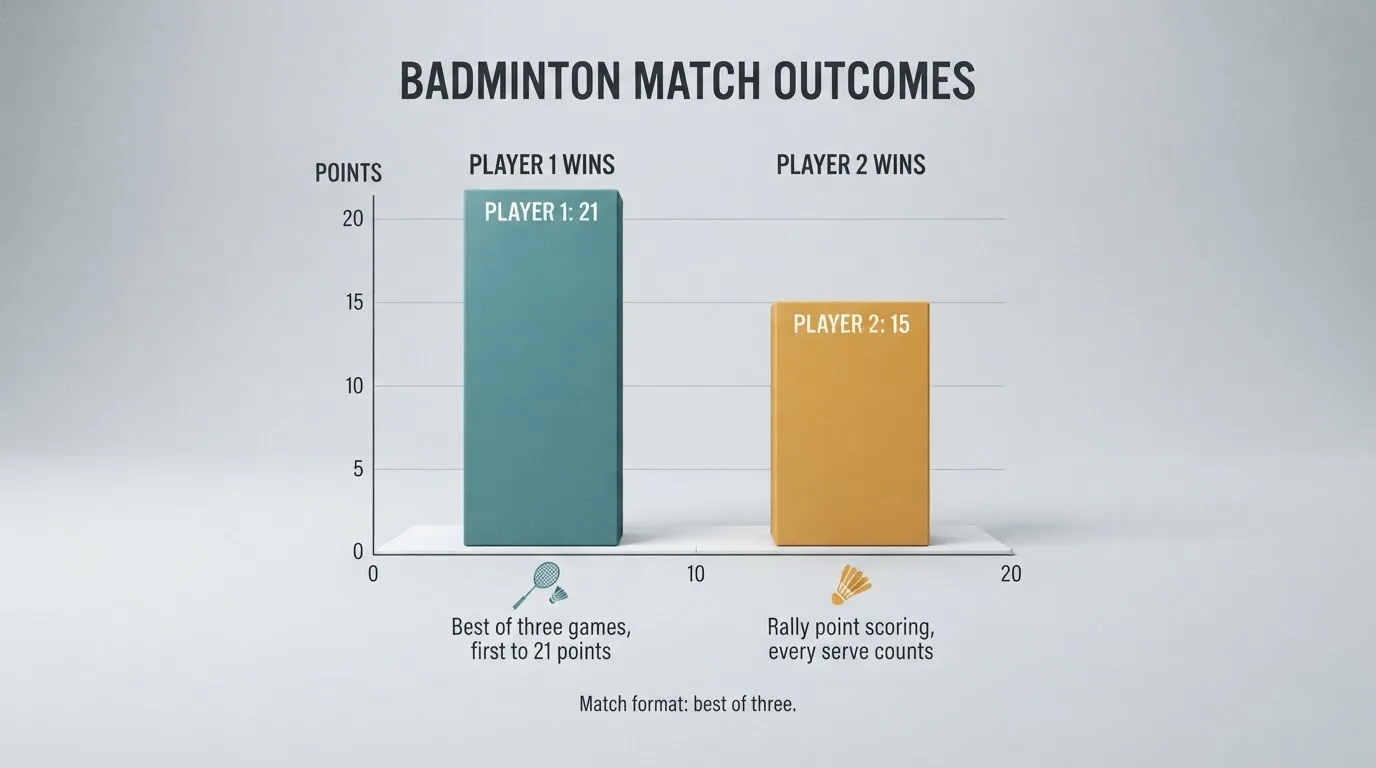
A badminton game is played to 21 points with rally point scoring. A match is the best of three games. At 20-20 play continues until one side leads by two; at 29-29 the next point wins. The game is short by tennis standards and the standard deviation of game length is high, which is why totals markets — over/under on total points in a game — carry a wide range of bookmaker prices. A service error at 20-19 costs the server the game; a let on the same point is replayed. The rules are simple once the rally point system is understood, and they sit behind every in-play market.
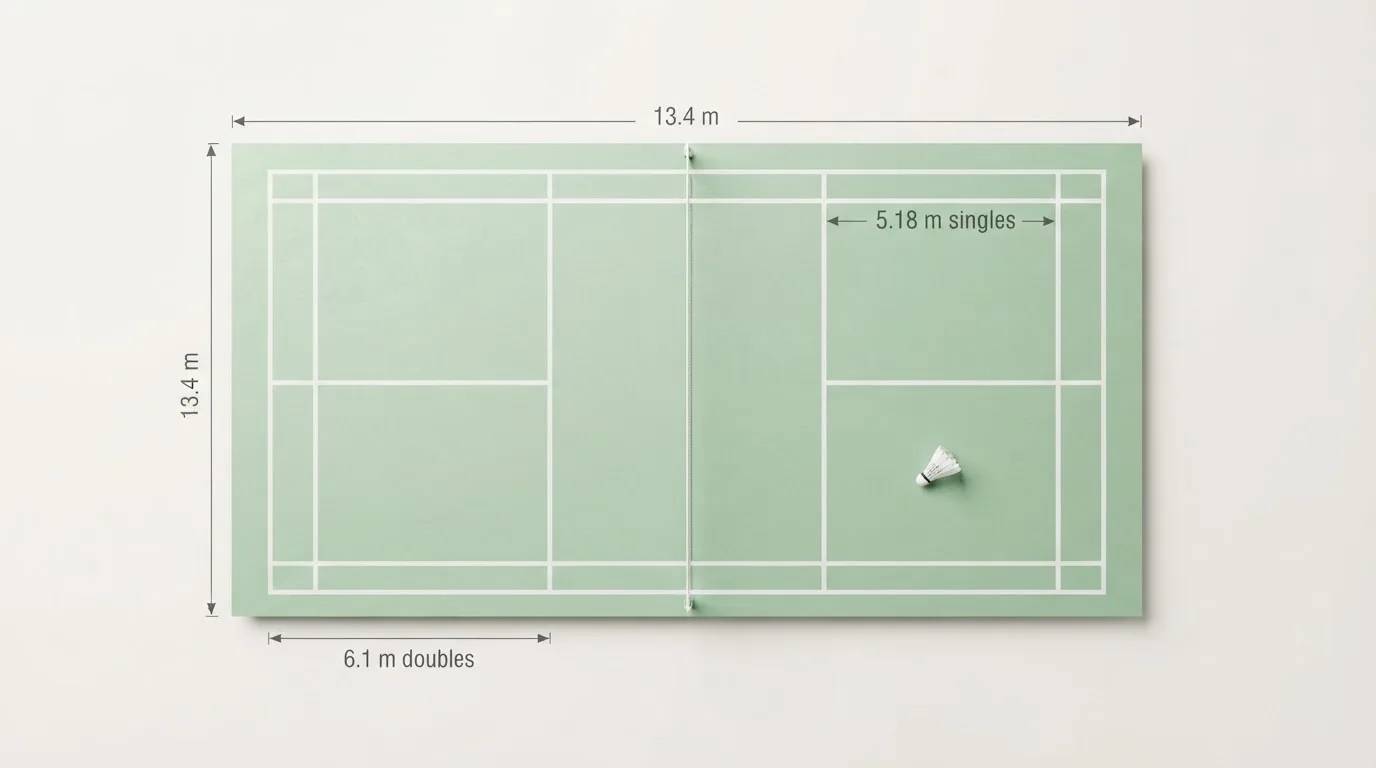
The court itself is 13.4 metres long, 6.1 metres wide for doubles and 5.18 metres wide for singles. The net stands 1.55 metres high at the edges and 1.524 metres at the centre. These dimensions do not change, and the lines on the court do not move; what changes is the surface, the lighting, the altitude and the shuttle, and each of those is a variable the punter can read before the match. A high-altitude venue drags the shuttle through the air differently and lengthens rallies; a slow shuttle on a synthetic court at sea level favours the defensive player. None of this decides a match on its own, and the punter who treats any single variable as decisive overrates its weight in the bookmaker’s price.
How the Calendar Reads in Practice
For the punter who follows the tour, the year breaks into three blocks. The first half of the year is dense with Super 500 and Super 750 events leading into the All England in March. The summer brings the Thomas and Uber Cups in even-numbered years and the Sudirman Cup in odd-numbered years, with the Olympic Games in the summer of 2028 as the single biggest card on the calendar. The autumn closes out the BWF World Tour, and December carries the BWF World Tour Finals. The bookmakers’ coverage tracks the calendar: heaviest in March, patchier through the summer and the autumn, and front-loaded again at the year-end Finals.
The practical consequence is that the punter who wants a regular betting card on badminton follows the BWF World Tour calendar and concentrates stakes around the higher-grade events. The punter who bets on the lower-grade events pays a heavier margin and reads a thinner in-play product, which is a real cost over a season.
Choosing a UK-Licensed Bookmaker for Badminton: A Comparison
The table below compares ten UK-licensed bookmakers on the Gambling Commission’s public register, focusing on the licence position and on what each operator’s own terms state for the kind of product a badminton punter uses most. The list is ordered as the operators appear in the register; it is not a ranking of value and not a recommendation. Each operator offers something the others do not, and the right bookmaker depends on what the punter bets on.
| Operator | Gambling Commission licence | Licence holder | What the operator’s own terms state on the key subject |
|---|---|---|---|
| Ladbrokes | 54743 (054743-R-330863-014) | LC International Limited | Odds boosts on horse and greyhound bets, Best Odds Guaranteed on UK and Irish racing, in-play betting, Acca Boost |
| Copybet | 53774 (053774-R-330743-010) | Copybet UK Limited | Best Odds Guaranteed all day, every day on UK and Irish racing; first past the post paid even if the winner is later disqualified |
| BoyleSports | 39469 (039469-R-319383-025) | Boylesports Enterprise | Acca Insurance with opt-in, minimum stake £5, minimum odds 1/2, refund up to £20 as a free bet expiring in 7 days, bets placed and settled same day |
| BetTom | 64959 (064959-R-339314-003) | Bet Tom Limited | Sports welcome offer: 50% back as a free bet up to £50 plus a matching 50% back up to £50 as free slot funds for casino |
| Tote | 54779 (054779-R-331321-008) | TDCO Limited | Best Odds Guaranteed on UK and Irish horse racing from 8 AM on race day, single and multiple bets; not on ante-post, tote or pari-mutuel |
| Swifty Sports | 58957 (058957-R-334734-006) | Swifty Global (UK) Ltd | Best Odds Guaranteed, Cash Out on horse racing and football, daily price boosts, live streaming, in-play; Bet Builder listed as coming soon |
| Fitzdares | 400 (000400-R-103839-030) | Fitzdares Limited | Cash out, accumulators, Lucky 15s, specials and antepost markets across horse racing, football, tennis, rugby, cricket, golf and American football |
| Betmaster | 65699 (065699-R-339929-002) | BM Solutions GB Ltd | General sports betting and casino terms stated; badminton coverage confirmed via standard sports product |
| Bet600 | 44731 (044731-R-323941-016) | Tyche Tech Limited | Best Odds Guaranteed on horse racing: starting price paid if bigger than early or show price taken |
| bet365 | 55148 (055148-R-331498-002) | Hillside (UK Sports) ENC | In-play betting, live streaming worldwide, Bet Track, Match Live, Live Golf Tracker for following bets in play |
The licence is the floor, not the ceiling. Every operator above holds a remote general betting standard (real events) licence and is registered for the protection regime that goes with it — GAMSTOP, deposit limits, vulnerability checks at the trigger the Commission has set, identity verification before the first deposit. What separates one operator from the next is what each builds on top of that floor. bet365 stands out for the breadth of its in-play product and its live streaming across badminton and other sports; Ladbrokes and Copybet are heavier on horse racing features that do not transfer to badminton; BoyleSports and BetTom show their welcome offers plainly in their own terms, which is what the punter needs to read before claiming.
Ladbrokes
Ladbrokes is operated in Great Britain by LC International Limited under Gambling Commission licence 54743. Its sports product includes odds boosts on horse and greyhound racing, Best Odds Guaranteed on UK and Irish racing, in-play betting and an Acca Boost on qualifying multiples. Badminton sits inside the standard sportsbook with a match-winner market on the bigger BWF events and an in-play offering on selected fixtures. The Acca Boost is the feature most relevant to the badminton punter who likes accumulators, and it should be checked for which sports and which minimum leg counts it applies to before any multi is built. Verdict: a credible mainstream bookmaker whose badminton coverage is solid on the bigger events and patchier on the lower grades.
Copybet
Copybet runs on Gambling Commission licence 53774, held by Copybet UK Limited. The operator’s product line emphasises Best Odds Guaranteed on UK and Irish racing and pays first past the post on horse racing even when the winner is later disqualified, which is a niche but generous feature for the racing punter. For badminton, Copybet offers a standard sportsbook and in-play on selected events, with a margin and product set typical of a mid-sized UK bookmaker. The racing features do not transfer to badminton, and the punter whose interest is racier should be aware of that gap. Verdict: a fair mid-market bookmaker whose strengths lie elsewhere than badminton.
BoyleSports
BoyleSports is licensed in Great Britain under account 39469 by Boylesports Enterprise. Its Acca Insurance is the named feature: opt in, stake at least £5, minimum odds of 1/2, and a maximum refund of £20 as a free bet that expires in seven days if one selection lets the punter down, with all selections placed and settled on the same day. The free bet is a free bet, so the stake is not returned on a win. For the badminton punter who builds accas on the BWF World Tour, acca insurance is a real safety net if one leg loses — and the £20 cap is the limit to know. Verdict: a sensible bookmaker for the acca builder, with the cost of the insurance sitting in the £20 cap rather than in a higher margin.
BetTom
BetTom runs on Gambling Commission account 64959, held by Bet Tom Limited. Its sports welcome offer is 50% back as a free bet up to £50, paired with a matching 50% back up to £50 as free slot funds for casino play. The offer covers two product types in one account, and from 19 January 2026 the Commission prohibits mixed-product wagering requirements, which means the two halves of this offer are settled under separate terms. The punter who wants the sports offer only should ignore the casino half; the punter who plays both gets two separate products rather than one bundle. Verdict: a useful entry-level offer for the new sports punter, with the casino leg a separate decision.
Tote
Tote holds Gambling Commission licence 54779 through TDCO Limited. Its sports product centres on UK and Irish horse racing, with Best Odds Guaranteed from 8 AM on race day on singles and multiples, excluding ante-post, tote and pari-mutuel bets. Tote’s name comes from the pool-betting heritage of the brand, and its sportsbook is a smaller part of the offer. Badminton is priced on the bigger BWF events and the in-play product is modest. Verdict: a heritage brand whose centre of gravity is racing; the badminton punter will find the headline offers elsewhere.
Swifty Sports
Swifty Sports runs under Gambling Commission account 58957, held by Swifty Global (UK) Ltd. The product mix includes Best Odds Guaranteed, Cash Out on horse racing and football, daily price boosts, live streaming and in-play betting, with Bet Builder listed as coming soon. The feature set is broad for a smaller operator, and the live streaming is the most relevant to the badminton punter who wants to bet in-play and watch at the same time. Verdict: a smaller bookmaker punching above its weight on features, with the in-play and streaming combination useful on the bigger BWF events.
Fitzdares
Fitzdares is licensed in Great Britain under Gambling Commission account 400, one of the older licences on the register, held by Fitzdares Limited. The app offers cash out, accumulators, Lucky 15s, specials and antepost markets across horse racing, football, tennis, rugby, cricket, golf and American football, with in-play live odds. The breadth of the sports book is a strength; the badminton coverage is shaped by the bigger BWF events rather than the lower grades. Verdict: a premium-tinged bookmaker whose product is broad and whose badminton card is event-led.
Betmaster
Betmaster operates in Great Britain under Gambling Commission account 65699, held by BM Solutions GB Ltd. Its sports product is a standard online bookmaker with a casino attached, and the badminton offering is the standard match-winner market on the bigger events with in-play on selected fixtures. Verdict: a sensible mid-market bookmaker for the punter who already has a relationship with the brand; the badminton-specific features are not what distinguishes it.
Bet600
Bet600 runs on Gambling Commission licence 44731, held by Tyche Tech Limited. Its named racing feature is Best Odds Guaranteed on horse racing, paid at the starting price if the SP is bigger than the early or show price taken. For badminton, the offering is a standard sportsbook with in-play on selected events. Verdict: a smaller UK-licensed bookmaker whose badminton offering is mainstream rather than specialised.
bet365
bet365 is operated in Great Britain by Hillside (UK Sports) ENC under Gambling Commission licence 55148. The product set includes in-play betting and live streaming of events worldwide, plus Bet Track, Match Live and a Live Golf Tracker for following bets in play. The in-play product is the deepest of any UK-licensed bookmaker on badminton because the live streaming carries the BWF World Tour and the bigger regional events, and the price update is the most granular. Verdict: the bookmaker to use when the bettor’s edge comes from watching the match and trading the price, which is exactly how an in-play badminton edge works.
The Market in Brief: What a UK-Licensed Bookmaker Gives the Badminton Punter
A bookmaker taking bets from customers in Great Britain has to be licensed by the Gambling Commission. The licence is a permission to operate, and the licence terms, the Commission’s Licence Conditions and Codes of Practice and the Remote Technical Standards spell out what the operator has to provide and what it is not allowed to do. Since the Gambling (Licensing and Advertising) Act 2014 an operator whose remote facilities are used in Great Britain needs a Commission licence wherever it is based — a Curaçao, Maltese or Gibraltar licence is not a substitute. The Commission’s public register, searchable by business name, trading name, domain or account number, is the only place to verify whether a brand holds a licence, and the punter should always check the register before opening an account.
Minimum age is 18. Identity verification — name, address and date of birth — has to happen before the first deposit, before any free bet or bonus can be claimed, and before any bet can be placed. Verification has been in force since 7 May 2019, and a licensed operator that does not verify cannot lawfully take the customer’s money. No anonymous play at a licensed site.
What may be bet on is set by the operator’s licence category and the operator’s own house rules, not by statute. The general betting standard (real events) licence covers badminton. In-play betting is permitted, and the controls on in-play are the operator’s licence conditions and the social responsibility code, not a statutory prohibition. Esports are treated like any other event; virtual events are a separate licence category. Politics, TV shows and novelty markets are offered by GB bookmakers and no statutory ban was found.
The bookmaker’s licence is the punter’s protection. A licensed operator is bound by the social responsibility code, the bonus cap (10x wagering from 19 January 2026), the GAMSTOP regime, the financial vulnerability check at the trigger the Commission has set and the credit-card ban in force since 14 April 2020. The punter who bets with a licensed operator gets those protections. The punter who bets with an unlicensed operator gets none of them, and has no British route to complain or recover funds if the operator withholds them. Enforcement against unlicensed operators is disruption — cease-and-desist notices, search-engine referrals, registrar and host work — not blanket blocking. The honest framing is not “safe versus unsafe” but “with protection versus without”.
The punter pays no tax on betting winnings in Great Britain. General Betting Duty is the operator’s tax on gross profits, currently 15% across the regime, with a higher remote betting rate of 25% taking effect from 1 April 2027 within that overall structure. Whether operators pass duty on through tighter odds is not established, and never write that the punter is charged duty. The punter who treats betting as a profession should ask HMRC or an adviser; the punter who bets recreationally pays no tax on winnings.
Safer Gambling: The Tools a Licensed Bookmaker Has to Offer
A UK-licensed remote bookmaker is required to offer the punter tools that limit spend, limit time, and exclude the customer from the product if the customer asks to be excluded. GAMSTOP is the national multi-operator online self-exclusion scheme and a mandatory licence condition for online operators since 31 March 2020. Periods are six months, one year, five years, or five years with auto-renewal; after the minimum period the exclusion stays in force for a further seven years unless the customer asks GAMSTOP to remove it. GAMSTOP covers online sites and apps; the betting shop register is a separate service. The punter who self-excludes through GAMSTOP cannot open a new account at any UK-licensed online operator for the period of the exclusion, and the operator is required to close any existing account and return the balance.
A financial vulnerability check has applied to licensed remote betting since 30 August 2024 (LCCP condition 3.4.4), and the deposits-minus-withdrawals trigger of £150 in a rolling 30-day period has been live since 28 February 2025. The check is a public-record check — bankruptcy, county court judgments, the register of insolvent estates — not an income check and not a credit reference check. The Commission has also announced a staged plan for fuller financial risk assessments; that plan has no published start date. The punter should expect to be asked for source-of-funds information at higher spend; that is normal under the money-laundering rules and not a sign of trouble.
Deposit limits are the operator’s tool, set by the punter on the operator’s safer gambling page. The Commission has set a cap on the time horizon a deposit limit can cover, with the first changes live since 31 October 2025 and a second phase that was postponed to 30 September 2026; whether the second phase is live is not established. There is no state-set ceiling on deposits or losses. Limits are the customer’s choice.
Help is available whether or not the punter has self-excluded. GamCare runs the National Gambling Helpline. GambleAware funds treatment and education. NHS gambling clinics provide specialist support. Gamblers Anonymous runs peer-support meetings. The punter who feels the build is gone should reach out before the next deposit, not after.
Frequently Asked Questions
How is a badminton bet actually placed?
A badminton bet is placed by choosing an event from the bookmaker’s sportsbook, picking a market — match winner, handicap, total points, first-game winner — and entering a stake. The bet is settled when the event finishes according to the bookmaker’s house rules, with winnings added to the balance and the stake returned alongside them. Verification of identity is required before the first bet, and a free bet or bonus has its own settlement rules.
What is a value bet, and why is no tip ever certain?
A value bet is a selection whose price is greater than the true probability of the outcome once the bookmaker’s margin is removed. The punter estimates the probability, compares it to the implied probability in the decimal odds, and acts only where the estimate exceeds the implied probability. No tip is certain because badminton is decided by fine margins, injuries and the variance of a short game; the punter who treats a tip as a forecast loses the discipline that lets the betting work at all.
What is the bookmaker’s margin and how can it be seen in the odds?
The margin is the percentage of every unit bet that the bookmaker keeps on average. It sits inside every set of odds. On a two-way market priced at 1.90 and 1.90 in decimal, the implied probabilities add to about 105.3%; the extra 5.3 percentage points are the margin. The payout share to the punter is roughly 94.9% on that market, and the bookmaker’s margin is the rest. Smaller margins sit on bigger events and on popular markets; larger margins sit on the lower grades and on exotic markets.
How is the return on a bet worked out from the stake and the odds?
The return on a winning single is the stake multiplied by the decimal odds. A £10 stake at 2.50 returns £25, profit £15. On a combination bet, the odds of the legs multiply into one price before the stake is applied. The return is the same formula — stake times combined odds — and the profit is the return minus the stake. A free bet follows the same formula except that the stake is not returned with a win, so a £10 free bet at 2.50 returns £15 in profit.
How can it be checked that a bookmaker holds a Gambling Commission licence?
The Commission’s public register is the only place to verify a licence, and it is searchable by business name, trading name, domain or account number. The punter should always check the register before opening an account, and should treat any brand whose licence cannot be found on the register as unlicensed for the purposes of placing a bet from Great Britain. A .co.uk domain does not prove a licence; licensed operators use .com as well as .co.uk.
Which tools for controlling play does a licensed bookmaker have to offer?
A UK-licensed remote bookmaker has to offer deposit limits, time-out, product restrictions and self-exclusion, and has to register the customer with GAMSTOP for the multi-operator self-exclusion scheme. A financial vulnerability check applies at the trigger the Commission has set, and the punter will be asked for source-of-funds information at higher spend. Help lines run by GamCare, GambleAware and the NHS are linked from the safer gambling page of every licensed operator.
Tennis, darts & cue sports – Rugbytipsters.com
Content created by the «Rugbytipsters.com» team
